Travelling to China
Chinese for your first trip to China
Updated
On a first trip to China, you need Chinese for three things: food, paying and getting around. You need only a few phrases, but you use them many times a day. This page shows when you need them, what to say, and where the game lets you practise.
What will happen
You meet most of these on your first day, and again every day after.
-
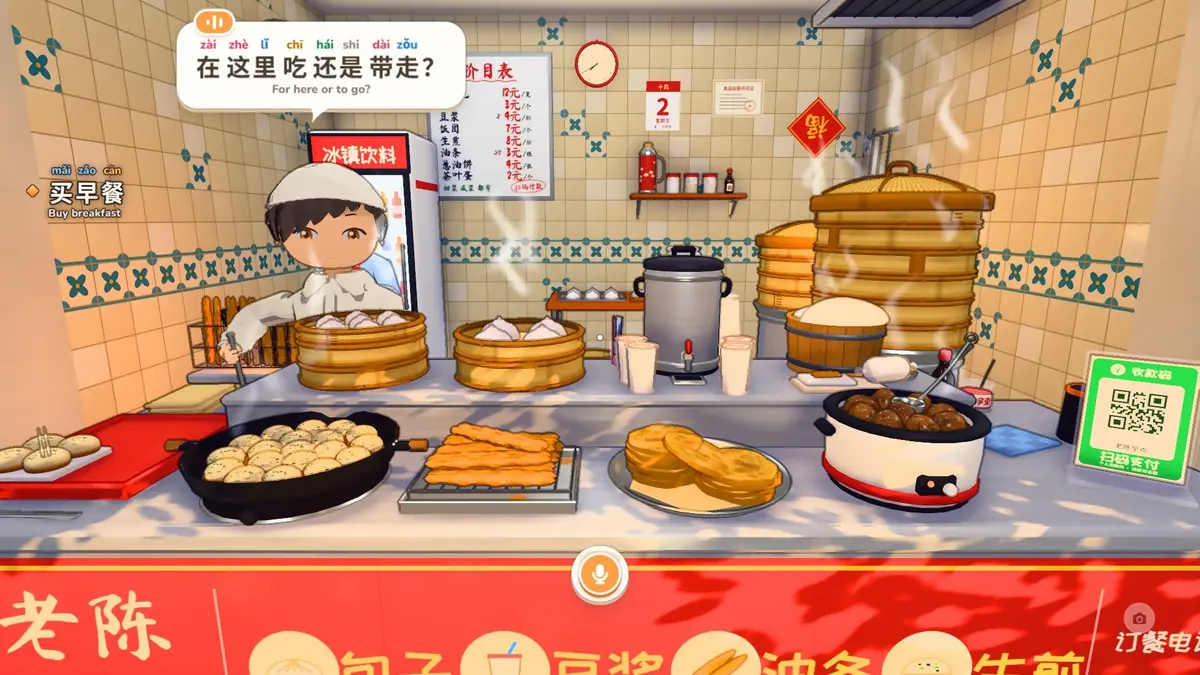
A breakfast stall with no English menu
Point at the food and say 这个 (this one). Breakfast stalls sell steamed buns, fried dough sticks, tea eggs and soy milk. The owner then asks how many you want, and whether you eat there or take it away.
-
Paying by phone
Most shops expect you to pay with a phone app such as Alipay or WeChat Pay. The counter has a printed QR code. You scan it, type the amount and show the cashier your screen. In bigger shops, the cashier scans a code on your phone instead.
-
Spicy or not
Noodle shops and night-market stalls often ask if you want your food spicy. If you do not answer, you get the shop’s usual amount of chili. That can be a lot.
-
Finding the metro
Metro entrances can be hard to see from the street, so you ask someone. Start with 不好意思 (excuse me). The first person may be in a hurry or not know. You may need to ask two or three people.
-
Ordering a drink
Bubble tea and coffee shops ask three things: the size (large, medium or small), how much ice, and hot or iced.
-
A day trip by high-speed train
You buy a train ticket with your passport, at a station window or in an app. At the station, you show your passport, go through a security check and get on at the carriage number on your ticket.
Phrases to learn
- 这个 (zhè ge) This one
Say it while you point at food or at a picture on the menu. It works at breakfast stalls, snack counters and bakeries.
They may say 包子?想要几个? (bāo zi? xiǎng yào jǐ ge?) Steamed bun? How many? (Then you answer with a number.) - 在这里吃 (zài zhè lǐ chī) For here
Say it when you want to eat at the stall or in the shop. To take the food with you, say 带走 (to go).
They may say 你坐那边,我给你端过去! (nǐ zuò nà biān, wǒ gěi nǐ duān guò qu!) You sit over there, I'll bring it over to you! - 扫码付款 (sáo mǎ fù kuǎn) Scan the code to pay
Say it when the cashier asks how you will pay. It tells them you will pay with your phone.
They may say 八块,扫这里。 (bā kuài, sǎo zhè lǐ.) 8 yuan. Scan here. (块 is the everyday word for yuan.) - 不要辣 (bú yào là) No spicy
Say it when someone asks 要辣吗 (do you want it spicy). For a little chili, say 有点辣 (a little spicy). For a lot, say 多放辣 (extra spicy).
They may say 牛肉面,要辣吗? (niú ròu miàn, yào là ma?) Beef noodles. Want spicy? (This is the question you hear first.) - 地铁站在哪里? (dì tiě zhàn zài ná li?) Where's the metro station?
Use it to ask the way to the metro. You can put another place before 在哪里 (where is): 洗手间 (restroom) or 药店 (pharmacy).
They may say 前面,右转 (qián mian, yòu zhuǎn) Up ahead, turn right. - 多少钱? (duō shao qián?) How much?
Use it to ask the price at a stall, a market or a shop counter.
- 大杯。 (dà bēi.) A large one.
Say it when you order a drink and they ask the size. A small one is 小杯 (small cup).
They may say 热的还是冰的? (rè de hái shi bīng de?) Hot or iced? - 一张去柳溪的票。 (yì zhāng qù liǔ xī de piào.) One ticket to Liuxi.
Say it at the ticket window in a train station. Liuxi is the small town you visit in the game. Use the name of your own destination.
They may say 护照 (hù zhào) Passport? (Tickets are issued in your name, so they need your passport.) - 真好吃! (zhēn hǎo chī!) Really tasty!
Say it when the owner asks 好吃吗 (is it good).
The pinyin shows how the words are really said, as in the game.
Where to practise it in the game
The game follows one visitor through a week in a present-day Chinese city. These scenes match a first trip.
The breakfast stall
On the first morning, you point at the food and say how many in Chinese. You choose to eat there or take it away, and you pay by scanning the code. If you order only soy milk, the owner asks you to pick something to eat too.
The noodle shop
You choose a large or medium bowl and say how spicy you want it. Then you build the sentence “I like to drink…” to order a drink. If you order a coffee, the owner is surprised and goes out to buy one for you.
Asking the way and the metro
You stop people in the street to ask where the metro is. Some are in a hurry and some do not know. An older woman with a shopping trolley shows you the way. At the station, you scan a code on your phone to go through the gate.
Night market and train day
At a night market, you ask if a dish is spicy and if there is a mild one. Later in the week, you buy a train ticket with your passport, go through the checks and ride to a small water town.
Practical tips
-
Set up a payment app before you land
Alipay and WeChat Pay are the two payment apps used across China. Both let visitors link a foreign Visa or Mastercard. Many street stalls take only QR code payments, so set one up and test it before the trip. Carry some cash as a backup. Fees and card rules change, so check the app’s current terms.
-
Use a transport code for the metro
In many cities, you can go through the metro gates by scanning a transport QR code in Alipay or WeChat. Check if your city supports it. If not, buy a ticket at a machine.
-
Book trains with your passport
Train tickets are issued in your name and linked to your passport number. You can buy them in the official railway app 12306, in travel apps, or at a station window. Bring your passport to the station.
-
Carry tissues
Malls, metro stations and large parks have free public restrooms. Some have no toilet paper.
-
Expect hot water
Restaurants often serve hot water or tea, not cold water. For a cold drink, ask for one or buy it at a convenience store.
Questions
Do I need to speak Chinese to travel in China?
No. You can travel in China with a translation app and by pointing. A few spoken phrases make it easier, because many stalls, small restaurants and taxi drivers do not use English. They ask the same questions every day: how many, for here or to go, and spicy or not.
What are the most useful Chinese phrases for tourists?
These six cover most of a first trip: 这个 (this one), 多少钱 (how much), 扫码付款 (pay by scanning the code), 不要辣 (no chili), 地铁站在哪里 (where is the metro station) and 谢谢 (thank you).
How do I order food in China if I can’t read the menu?
Point at the food or a picture and say 这个 (this one). Then say how many you want. At breakfast stalls and counters, you also hear 在这里吃还是带走 (for here or to go).
How do I say “not spicy” in Chinese?
Say 不要辣 (no chili) when someone asks 要辣吗 (do you want it spicy). For a little chili, say 有点辣 (a little spicy). For extra chili, say 多放辣 (extra spicy).
Can tourists pay with their phone in China?
Yes. Tourists can pay with Alipay or WeChat Pay after linking a foreign Visa or Mastercard. You either scan the shop’s QR code, type the amount and show the screen, or let the cashier scan a code on your phone.
Is the game set in a real Chinese city?
No. Very Chinese Time in My Life is set in a made-up, present-day Chinese city. It has the places a visitor usually goes: an airport, a hotel, a breakfast stall, a mall, a noodle shop, the metro, a park, a night market, a pharmacy and a high-speed train station. The names of places and people are made up.
Sources
Official pages for the facts on this page. Rules change, so check them before you travel.
- The State Council of China: Payment guide seen as assisting opening-up (People’s Bank of China guide for foreigners)How visitors pay in China with bank cards, cash and mobile payment apps such as Alipay and Weixin Pay (WeChat Pay).
- Alipay: American Express and Alipay to enable payments for international travelers in China (February 2025)International visitors can link cards from seven major card brands to Alipay.
- China Railway 12306 (English)The official site for buying train tickets in China, with an English version.