Travelling alone
Chinese for travelling solo in China
Updated
Travelling alone in China is easy until something goes wrong. Then there is nobody to help you explain. Strangers also talk to solo travellers a lot. This page gives the phrases for both: chatting with strangers, and explaining a problem yourself.
What happens when you travel alone
-
“By yourself?”
Drivers, stall owners and people at the next table often ask if you came alone. It is a way to start a chat. When you say yes, they are usually impressed.
-
Finding a seat
At busy night markets and small restaurants, strangers share tables. You ask if there is a free seat and if you can sit down.
-
Asking strangers
With no travel partner, you ask strangers for everything: the way, a price, the restroom. Some will be busy or not know. Ask the next person.
-
A lost phone
In China, your phone is your map, wallet and translator. If you lose it, you explain at the hotel desk or a police station what happened, when, and what the phone looks like.
-
Getting sick
If you get a stomach ache, you have to ask where a pharmacy is, say what is wrong, and ask how often to take the medicine.
Phrases to learn
- 一个人? (yí ge rén?) By myself.
Say it when someone asks if you came alone.
They may say 一个人跑这么远,厉害! (yí ge rén pǎo zhè me yuǎn, lì hai!) One person, running this far. Impressive! - 有位子吗? (yǒu wèi zi ma?) Is there a seat?
Ask it when you walk into a busy place or come up to a full table.
- 我可以坐这里吗? (wǒ ké yǐ zuò zhè lǐ ma?) Can I sit here?
Use it to ask if you can share a table. People often wave and say “sit, sit”.
They may say 坐坐坐! (zuò zuò zuò!) Sit, sit, sit! - 不好意思 (bù hǎo yì si) Excuse me
Say it before you ask a stranger anything.
They may say 不好意思,我赶时间! (bù hǎo yì si, wǒ gǎn shí jiān!) Sorry, I'm in a hurry! (Then ask the next person.) - 我的手机丢了。 (wǒ de shǒu jī diū le.) My phone is lost.
Say it at the hotel front desk or at a police station.
They may say 在哪里丢的? (zài ná li diū de?) Where was it lost? - 昨天晚上 (zuó tiān wǎn shang) Last night
Use it to answer 什么时候丢的 (when did you lose it).
- 我肚子疼。 (wǒ dù zi téng.) I have a stomachache.
Say it at the front desk or at a pharmacy.
They may say 你好,哪里不舒服? (ní hǎo, ná li bù shū fu?) Hello, where do you feel unwell? - 一天几次? (yì tiān jǐ cì?) How many times a day?
Ask it at the pharmacy to check how many times a day to take the medicine.
They may say 一天三次。 (yì tiān sān cì.) Three times a day.
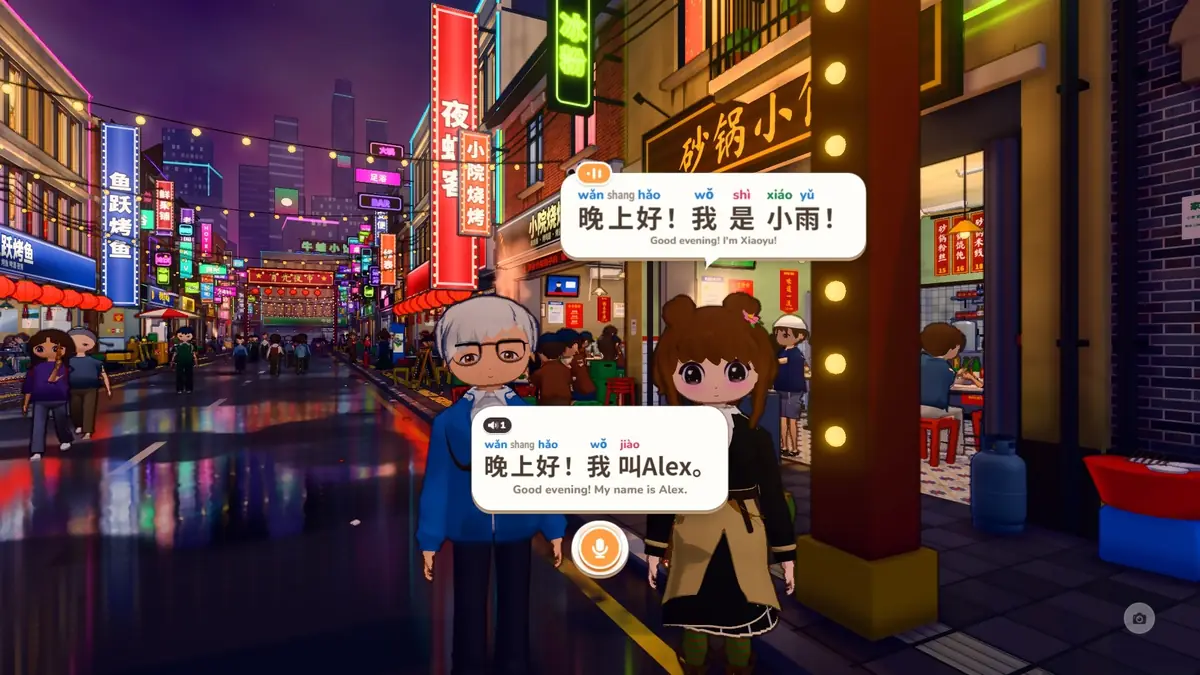
The pinyin shows how the words are really said, as in the game.
Where to practise it in the game
The player in the game travels alone, so most scenes are solo-travel situations.
The night market
You ask if there is a seat and if you can sit at a table. You end up eating with locals who ask your name and if you came alone.
Losing your phone
One morning, your phone is gone. You ask at the hotel desk, then go to the local police station. You answer when and where you lost it, and say its colour. The police make some calls and send you to where it was found.
A stomach ache
You wake up with a stomach ache and ask where a pharmacy is. You tell the pharmacist what is wrong and what you ate. When she explains too fast, you ask her to slow down.
Being on your own
A driver asks if you came alone and is impressed when you say yes. A bathhouse attendant asks the same. In a water town, an umbrella seller lowers the price because your Chinese is good.
Practical tips
-
Know the emergency numbers
Call 110 for the police, 120 for an ambulance and 119 for the fire service.
-
Keep your address on paper
Write the hotel’s name and address in Chinese on paper, and keep it away from your phone. If you lose the phone, it is the first thing people ask for.
-
Carry a power bank
You use your phone to pay, find your way, show tickets and translate. If the battery dies, you can do none of these.
-
Share your plans
Send your plans and hotel details to someone at home. Message them when you move to a new city.
Questions
Is it easy to travel alone in China without speaking Chinese?
Yes, with translation and payment apps, and many solo travellers do it. It gets harder when something goes wrong, like a lost phone or an illness, because nobody is there to help you explain. Learn a few phrases for those moments.
What do I do if I lose my phone in China?
Tell your hotel’s front desk first. Then report it at the nearest local police station, a 派出所 (police station). Say 我的手机丢了 (my phone is lost). Be ready to say when and where you lost it and what colour it is.
How do I ask to share a table in Chinese?
Ask 有位子吗 (is there a seat) or 我可以坐这里吗 (can I sit here). Sharing tables with strangers is common at busy night markets and small restaurants in China.
How do I describe a stomach ache at a Chinese pharmacy?
Say 我肚子疼 (I have a stomach ache). For diarrhoea, say 拉肚子 (diarrhoea). The pharmacist asks what you ate, then tells you how often to take the medicine, for example 一天三次 (three times a day).
Why do people in China ask if I am travelling alone?
They are curious and want to chat. They ask 一个人 (by yourself), and often praise you for travelling so far alone. Answering 一个人 (by myself) usually starts a friendly conversation.
What is the emergency number in China?
Call 110 for the police, 120 for an ambulance and 119 for the fire service.