Travelling to China
Chinese for a visa-free stopover in China
Updated
A visa-free stopover is a stay of a few days in China between two flights. You need about ten phrases for it. This page lists them in the order you will use them: the airport, the hotel, breakfast, the metro and a day out.
A typical first 48 hours
-
Hour 0: the arrivals exit
Drivers may come up and offer you a ride. These rides are unofficial and often cost more. Say no and keep walking to the taxi rank or the car you booked.
-
Hour 1: the ride into town
The driver may say hello and ask where you are from. You do not have to chat. A hello at the start and a thank-you at the end are enough.
-
Hour 2: hotel check-in
Every hotel needs your passport to register your stay. Staff may first ask for a Chinese ID card out of habit.
-
Morning: breakfast
You eat at a stall or small shop near the hotel. Point at the food, say a number, and pay by scanning the shop’s QR code with a payment app.
-
Midday: the metro
You will probably need to ask the way. Say 不好意思 (excuse me) first, then name the place.
-
Any time: not understanding
Some people answer fast and at length. Tell them you do not understand and ask them to speak more slowly.
Ten phrases to learn before the flight
In the order you will need them.
- 不用了,谢谢 (bú yòng le, xiè xie) No need, thanks
Say it to drivers at the arrivals exit, and to anyone selling something you do not want.
They may say 真的不要? (zhēn de bú yào?) You really don't want it? (Say 不用了 (no need) again.) - 我是外国人 (wǒ shì wài guó rén) I'm a foreigner
Say it when a hotel desk or a gate asks for a Chinese ID card. They will then ask for your passport.
They may say 哦,不好意思!护照给我一下。 (ò, bù hǎo yì si! hù zhào gěi wǒ yí xià.) Oh, sorry! Give me your passport, please. - 护照 (hù zhào) Passport
You hear this word at the hotel, the ticket window and the station gates.
They may say 护照呢? (hù zhào ne?) And your passport? (Station staff say this when they want to see it.) - 扫码付款 (sáo mǎ fù kuǎn) Scan the code to pay
Say it to pay with your phone, or when the cashier asks how you will pay.
They may say 扫码还是现金? (sáo mǎ hái shi xiàn jīn?) Scan the code or cash? (The cashier is asking how you will pay.) - 这个 (zhè ge) This one
Say it while you point at food or at something on a shelf.
- 多少钱? (duō shao qián?) How much?
Use it to ask the price before you buy.
- 地铁站在哪里? (dì tiě zhàn zài ná li?) Where's the metro station?
Use it to ask the way to the metro. Say 不好意思 (excuse me) first.
They may say 前面,右转 (qián mian, yòu zhuǎn) Up ahead, turn right. - 洗手间在哪里? (xí shǒu jiān zài ná li?) Where is the restroom?
Use it to ask where the restroom is.
- 听不懂,请慢一点。 (tīng bu dǒng, qǐng màn yì diǎn.) Don't understand, please a bit slower.
Say it when an answer is too fast or too long to follow.
They may say 好的好的,我慢慢说。 (hǎo de hǎo de, wǒ màn man shuō.) OK, OK, I will say it slowly. - 谢谢 (xiè xie) Thank you
Say it to thank anyone. The usual reply is 不客气 (you’re welcome).
They may say 不客气! (bú kè qi!) You're welcome!
The pinyin shows how the words are really said, as in the game.
Where to practise it in the game
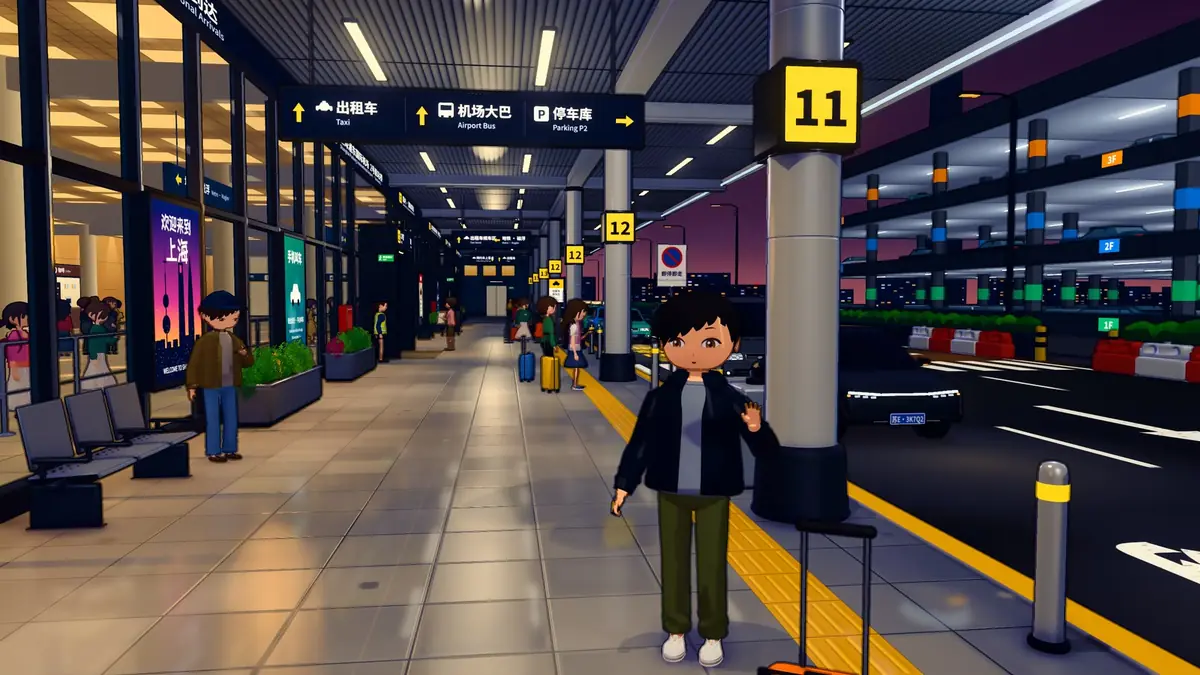
The game’s first night is a stopover arrival: the airport, a car and a hotel. The next days cover breakfast, paying and the metro.
Arrivals exit at night
Two drivers try to sell you a ride. You learn to say “no”, then “no need, thanks”. The second driver asks again before he leaves.
Hotel desk
The receptionist asks for an ID card without looking up. You say you are a foreigner, say the word for passport to take it out, and look at the camera on the desk.
Breakfast and the street
The next morning, you order at a stall and pay by scanning the code. The day after, you ask strangers the way to the metro and scan in at the gate.
High-speed rail station
Later in the week, you buy a ticket at the window with your passport. The automatic gate shows a red cross, so a staff member sends you to the staffed lane, where she checks your passport.
Practical tips
-
Check the transit rules before you book
Travellers from more than 50 countries can stay up to 240 hours (10 days) without a visa if they fly on to a third country or region. You must enter through certain airports and ports and stay inside the permitted areas. The lists change, so check the National Immigration Administration’s current rules or ask your airline.
-
Have your onward ticket ready
At immigration, you show a confirmed ticket out of China to a third country or region, with a fixed date and seat. Keep it on your phone and bring a printed copy.
-
Keep your passport with you
Hotels register you with it, and train tickets are issued in the name on it. On train days, carry it. Do not leave it in the hotel safe.
-
Set up a payment app at home
Most shops in China take Alipay or WeChat Pay. Both let visitors link a foreign card. With only a day or two, set one up and test it before the flight.
-
Leave extra time at stations
Stations check your passport and bags before the platform. Some automatic gates read foreign passports and some do not, so you may have to use the staffed lane. Arrive early.
Questions
How long can I stay in China on visa-free transit?
Up to 240 hours (10 days), if you come from an eligible country and fly on to a third country or region. As of August 2026, 57 countries were eligible. The lists of countries, entry ports and permitted areas change, so check the National Immigration Administration’s current rules or ask your airline before booking.
What Chinese do I need for a short stopover in China?
About ten phrases cover most of a stopover: 不用了,谢谢 (no need, thanks), 我是外国人 (I’m a foreigner), 护照 (passport), 扫码付款 (pay by scanning the code), 这个 (this one), 多少钱 (how much), 地铁站在哪里 (where is the metro station), 洗手间在哪里 (where is the restroom), 听不懂,请慢一点 (I don’t understand, please speak more slowly) and 谢谢 (thank you).
Do hotels in China accept foreigners on transit?
Yes. Hotels in China can take foreign guests, including travellers on visa-free transit, and register them with the passport. A few small hotels still turn foreigners away, so confirm when you book. If the receptionist asks for a Chinese ID card, say 我是外国人 (I’m a foreigner) and hand over your passport.
Can I take a high-speed train during a visa-free transit stay?
Yes, within the areas your stay allows. Tickets are issued in the name on your passport, and you show the passport at the station. Some automatic gates read foreign passports. At others, you use a lane where staff check it by hand.
How do I get from the airport to the city without speaking Chinese?
Use the official taxi rank, the metro, or a ride-hailing app. DiDi is the main ride-hailing app in China. It has an English version and also works inside Alipay. If drivers come up to you in the arrivals hall, say 不用了,谢谢 (no need, thanks).
Is a game a realistic way to prepare for a short trip?
Yes, if the game has you say the phrases out loud in the places you will use them. Very Chinese Time in My Life starts with a stopover arrival: the airport exit, a car to the hotel, and checking in with a passport.
Sources
Official pages for the facts on this page. Rules change, so check them before you travel.
- National Immigration Administration: China’s visa-free transit policy fully relaxed and optimized (December 2024)The stay for visa-free transit extended to 240 hours (10 days), for travellers going on to a third country or region.
- National Immigration Administration: Announcement No. 4 of 2026 on the 240-hour visa-free transit policy57 eligible countries and 65 ports of entry from 20 August 2026; a confirmed onward ticket to a third country or region is required.
- National Immigration Administration: Regulations on filing accommodation registration for foreignersHotels register foreign guests; anyone staying elsewhere registers with the local police within 24 hours.
- The State Council of China: Payment guide seen as assisting opening-up (People’s Bank of China guide for foreigners)How visitors pay in China with bank cards, cash and mobile payment apps such as Alipay and Weixin Pay (WeChat Pay).
- China Railway 12306 (English)The official site for buying train tickets in China, with an English version.