Family and heritage
For heritage speakers who understand Chinese but don’t speak it
Updated
A heritage speaker grew up hearing Chinese at home. Many understand a family dinner in Chinese but answer in English, because nobody asked them to speak it. The gap is usually confidence, a few unsure tones, and sentences they have never built themselves. Practising out loud in private, with no relatives listening, helps with all three.
Where does the gap show?
-
At the family table
A grandparent asks you something in Mandarin. You understand it, but answer in English or with one word.
-
Visiting relatives in China
People in China may expect you to speak Chinese because of your family. When you hesitate, someone may ask if you are Chinese.
-
Tones you are not sure of
You can hear when a word sounds right. When you say it yourself, you may not know if the tone goes up or down. This happens most with words you heard but never saw written.
-
Polite and everyday forms
Chinese at home is often casual. You may never have greeted a shopkeeper, asked a stranger the way, or spoken politely to an older person outside the family.
-
Building a sentence
You know the words one by one. You have rarely had to put them together while someone waits.
Phrases you probably know but rarely say
Short, common phrases. You say each one out loud in the game. The pinyin shows how the words are really said, the way you heard them at home.
- 奶奶好 (nǎi nai hǎo) Hello, grandma
The greeting for a grandmother when you arrive. 奶奶 (grandma) plus 好 (good) makes a greeting.
- 爷爷你好 (yé ye ní hǎo) Hello, grandpa
Say it to a grandfather, or to an older man you are introduced to.
- 只会一点点 (zhǐ huì yì dián diǎn) Only a tiny bit
Say it when someone asks if you speak Chinese. Saying it in Chinese also shows you speak some.
They may say 一点点?说得很好了! (yì dián diǎn? shuō de hěn hǎo le!) A tiny bit? You speak very well! - 听不懂,请慢一点。 (tīng bu dǒng, qǐng màn yì diǎn.) Don't understand, please a bit slower.
Say it when a relative talks fast, or in a dialect you do not know.
They may say 好的好的,我慢慢说。 (hǎo de hǎo de, wǒ màn man shuō.) OK, OK, I will say it slowly. - 我想喝茶。 (wǒ xiǎng hē chá.) I want to drink tea.
A full sentence: 我想 (I want to) plus 喝茶 (drink tea). The game teaches sentences like this one word at a time.
- 我不会 (wǒ bú huì) I don’t know how
Say it when you are asked to help with something new, like wrapping dumplings.
They may say 不会?我教你! (bú huì? wǒ jiāo nǐ!) Can't? I'll teach you! - 不好意思 (bù hǎo yì si) Excuse me
Say it to stop a stranger and ask the way. Most talks with strangers start with it.
They may say 哎,什么事? (āi, shén me shì?) Oh? What is it? - 不客气! (bú kè qi!) You're welcome!
It means “you’re welcome”. Here 不 becomes bú, because the next syllable has a falling tone.
The pinyin shows how the words are really said, as in the game.
Where to practise it in the game
The game is built around speaking. Your answers appear on cards, and you choose one by saying it out loud. You can click instead.
Word by word, then the sentence
New phrases appear as cards with pinyin above each character, coloured by tone. You say each word, the cards join, and then you say the whole sentence. Many heritage speakers have never practised this step.
A family lunch
Day 4 is a family visit. You greet the grandparents, choose a tea, learn to wrap dumplings, answer questions at the table and say you are full.
“Are you Chinese?”
A child on the metro platform asks if you are Chinese. At the breakfast stall, a woman in the queue asks if you are from somewhere else. Both times, you answer that you are a foreigner.
Reviews that come back
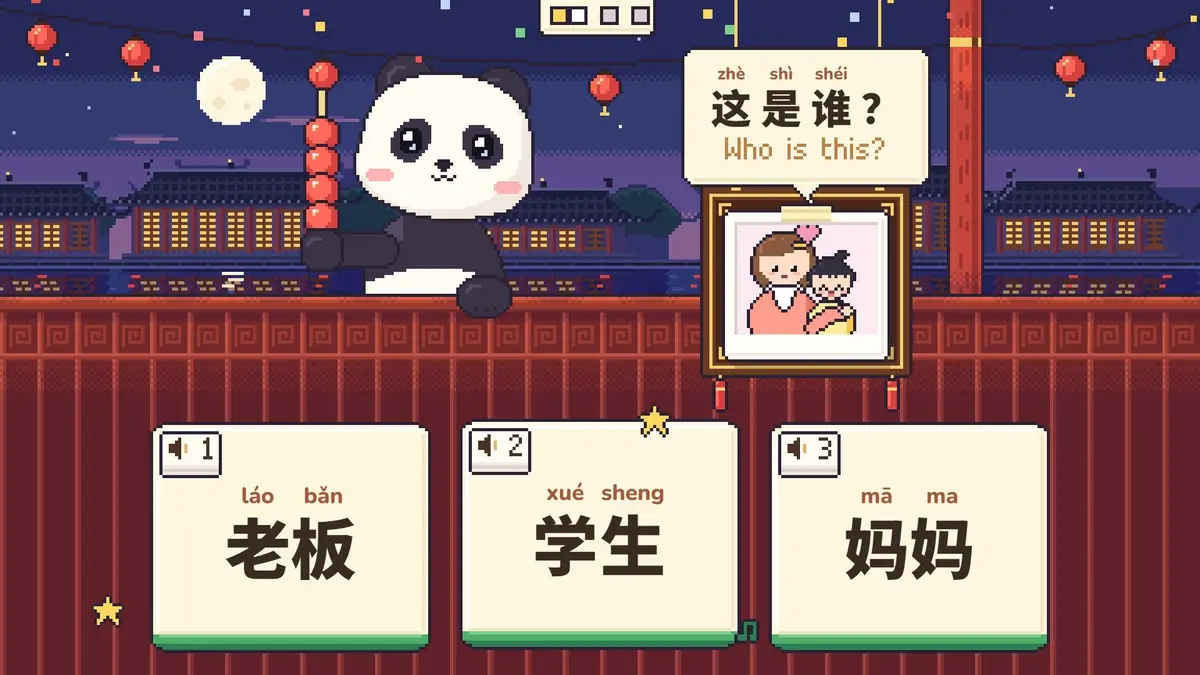
A panda quizzes you during the day, and a friend quizzes you by message every night. The phrases come back until you can say them without thinking.
Practical tips
-
Practise where nobody is listening
For many heritage speakers, the hardest part is speaking in front of family. Practise alone and out loud first.
-
Say it, then check the tone
Say the word the way you remember it, then check the tone colour or mark. Words you have heard all your life are usually right. Words you are guessing are where mistakes happen.
-
Check which language your family speaks
Your family may speak Cantonese, Hokkien or another Chinese language at home. They share many words with Mandarin but sound different. The game teaches Mandarin.
-
Start with greetings
Greet each relative in Chinese at every visit. It is easy, and relatives notice it.
Questions
Why can I understand Chinese but not speak it?
Because you heard it every day but were rarely asked to answer in it. Listening and speaking are separate skills. Speaking improves only by saying sentences out loud, and that is what most heritage speakers have practised least.
How can a heritage speaker practise speaking Mandarin?
Say whole sentences out loud in everyday situations, starting with ones you already understand. Very Chinese Time in My Life gives you this practice in private: you say each phrase to the characters in the game, and they react to what you said.
Is the game too easy if I already understand a lot?
No. The listening may be easy, but you have to say every answer yourself, out loud. That is usually the hard part.
Why is the pinyin in the game different from my textbook?
The game writes pinyin the way words are said. 你好 (hello) is ní hǎo and 不客气 (you’re welcome) is bú kè qi. Textbooks write each character’s dictionary tone instead: nǐ hǎo, bù kè qi. The game matches what you hear people say.
Does the game teach Cantonese?
No. Very Chinese Time in My Life teaches Mandarin with simplified characters. Speakers from Cantonese-speaking families will know many words, but the sounds are different.