Family and partners
Chinese for meeting your partner’s family
Updated
When you meet a partner’s family, short Chinese sentences are enough. The family notices what you say yourself: a greeting at the door, thanks for the tea, a word about the food. This page goes through a typical visit in order, with a phrase for each part.
How the visit usually goes
-
Arriving with a gift
Guests usually bring something, often fruit. The family may say you did not need to. That is just polite. Give the gift anyway.
-
Greeting each person
Greet each person as you come in. Older relatives are called by a family title, like “grandma” or “auntie”, not by name. This is the part of the visit people notice most.
-
Sitting down with tea
The family asks you to sit and offers tea straight away, often green or black tea.
-
Helping in the kitchen
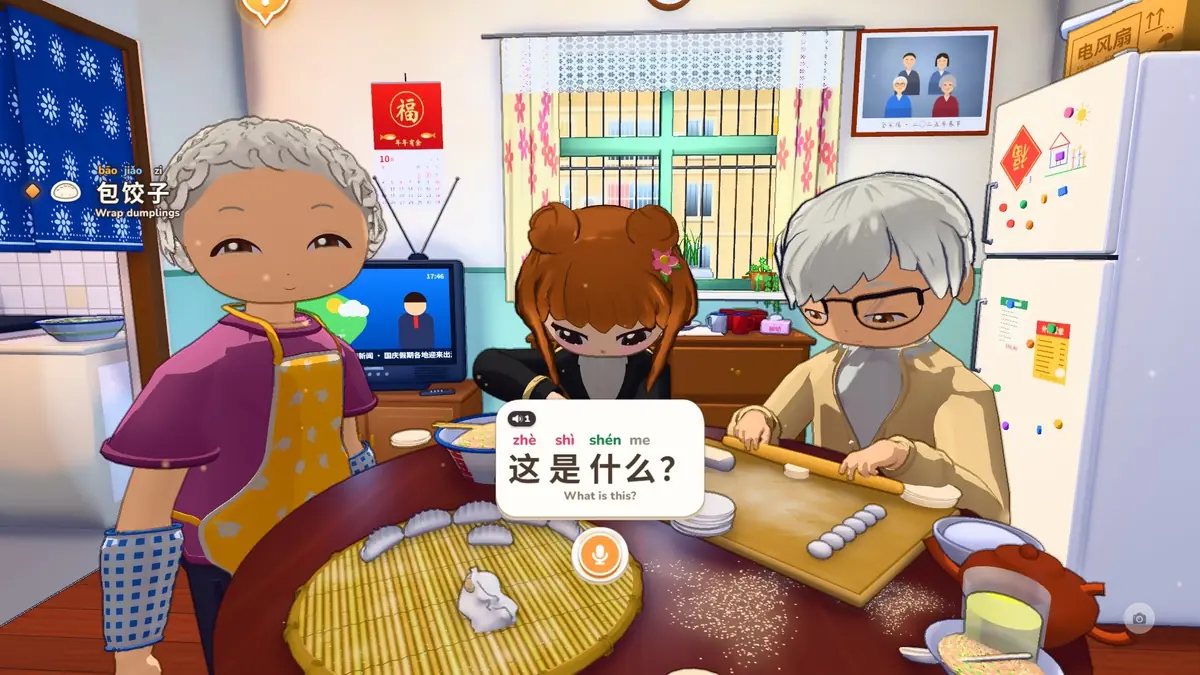
If they are making dumplings, they will invite you to try. Nobody expects you to be good at it. Someone will show you how.
-
The questions
They may ask where you live, if you like it here and how long you have studied Chinese. Short answers in Chinese are what they will remember.
-
More food than you can eat
Hosts keep putting food on your plate. Saying you are full once may not be enough. Finish the last dumpling and you may get another.
Phrases to learn
- 奶奶好 (nǎi nai hǎo) Hello, grandma
Say it to greet a grandmother when you come in. 奶奶 (grandma) plus 好 (good) makes a greeting.
They may say 快进来快进来! (kuài jìn lái kuài jìn lái!) Come in, come in! - 爷爷你好 (yé ye ní hǎo) Hello, grandpa
Say it to greet a grandfather. 爷爷 (grandpa) is the title.
- 阿姨 (ā yí) Auntie
Use it for a partner’s mother before you are married. To greet her, say 阿姨好 (hello, auntie).
- 叔叔 (shū shu) Uncle
Use it for a partner’s father before you are married. To greet him, say 叔叔好 (hello, uncle).
- 我想喝茶。 (wǒ xiǎng hē chá.) I want to drink tea.
Say it when they offer you something to drink.
They may say 绿茶还是红茶? (lǜ chá hái shi hóng chá?) Green tea or black tea? - 我不会 (wǒ bú huì) I don’t know how
Say it when they ask if you can make dumplings. They will show you how.
They may say 不会?我教你! (bú huì? wǒ jiāo nǐ!) Can't? I'll teach you! - 这样? (zhè yàng?) Like this?
Ask it to check you are doing it right while they watch.
They may say 对对对! (duì duì duì!) Right right right! - 真好吃! (zhēn hǎo chī!) Really tasty!
Say it about the food. Saying it more than once is normal.
- 够了够了 (gòu le gòu le) That’s enough, that’s enough
Say it when they keep putting food on your plate. Saying it several times is normal and polite.
They may say 多吃点多吃点! (duō chī diǎn duō chī diǎn!) Eat more, eat more! (You usually hear this first.)
The pinyin shows how the words are really said, as in the game.
Where to practise it in the game
Day 4 of the game is a full family visit, from buying the gift in the morning to the evening.
Buying the gift
A message invites you to make dumplings with a family the next day. In the morning, you buy fruit near the hotel. You ask the price, ask if the fruit is sweet, and say it is a gift.
The stairwell
You help an older woman carry her shopping up to the fifth floor. At the door, you find out she lives in the flat you are visiting.
The dumpling lunch
You greet the grandparents, choose a tea and learn to wrap a dumpling. The family asks where you live, and you show them your photos. They add you on WeChat, the messaging app most people in China use. At the table, they offer vinegar and chili, keep serving you and make a toast.
Square dancing
In the evening, the family takes you to the square, where neighbours dance together to music. The dancers ask if you are tired, and you try a couple of songs.
Practical tips
-
Bring fruit or a small gift
Good fruit, tea or something from your home country are common gifts. Your partner knows what the family likes.
-
Ask your partner what to call everyone
Family titles depend on the exact relationship. Before marriage, people usually call a partner’s parents 叔叔 (uncle) and 阿姨 (auntie), and the grandparents 爷爷 (grandpa) and 奶奶 (grandma). Your partner may tell you different ones.
-
Expect slippers at the door
Many families take off their shoes at the door and wear indoor slippers. They will offer you a pair.
-
Leave a little on your plate
In many families, an empty plate means you are still hungry, so it gets refilled. Leave a little and say you are full. You may need to say it more than once. Families differ, so watch your partner.
Questions
What should I say when I meet my Chinese partner’s parents?
Greet each person as you come in. Say 叔叔好 (hello, uncle) to the father and 阿姨好 (hello, auntie) to the mother. These are the usual titles before marriage. Greet grandparents with 爷爷好 (hello, grandpa) and 奶奶好 (hello, grandma). A greeting to each person matters more than any long sentence.
What gift should I bring to a Chinese family dinner?
Fruit is the most common gift. Tea or a small specialty from your home country also work. Your partner will know what the family likes.
How do I say “I’m full” politely in Chinese?
Say 吃饱了 (I’m full) or 够了够了 (that’s enough, that’s enough). Hosts often keep serving after the first time, so repeat it with a smile.
How do I compliment the food in Chinese?
Say 真好吃 (really tasty). If you helped make the dumplings, they may ask who made one. You can answer 我包的 (I wrapped it).
What if I can’t understand the family?
Say 听不懂,请慢一点 (I don’t understand, please speak more slowly). Most families are happy to slow down for someone who is trying. Your partner can help with the rest.
Does the game teach Cantonese for a Cantonese-speaking family?
No. Very Chinese Time in My Life teaches Mandarin only. A family that speaks Cantonese or another Chinese language at home usually understands Mandarin too, but their own language sounds different.