Studying in China
Chinese for studying abroad in China
Updated
Students in China usually arrive knowing some Chinese, but the first weeks are still hard. Outside the university, people speak at full speed. They also ask foreign students the same few questions. This page lists those questions, with answers you can prepare.
Outside the classroom
-
The questions every foreign student gets
Where are you from? Are you a student? How long have you studied Chinese? Did you come alone? Drivers, shop owners, classmates and older people ask these, often in the first minute.
-
Adding people on WeChat
WeChat is the messaging app most people in China use, for friends, group projects, class news and even landlords. After a good chat, someone may suggest adding each other. One of you shows a QR code in the app, and the other scans it.
-
Ordering drinks and food
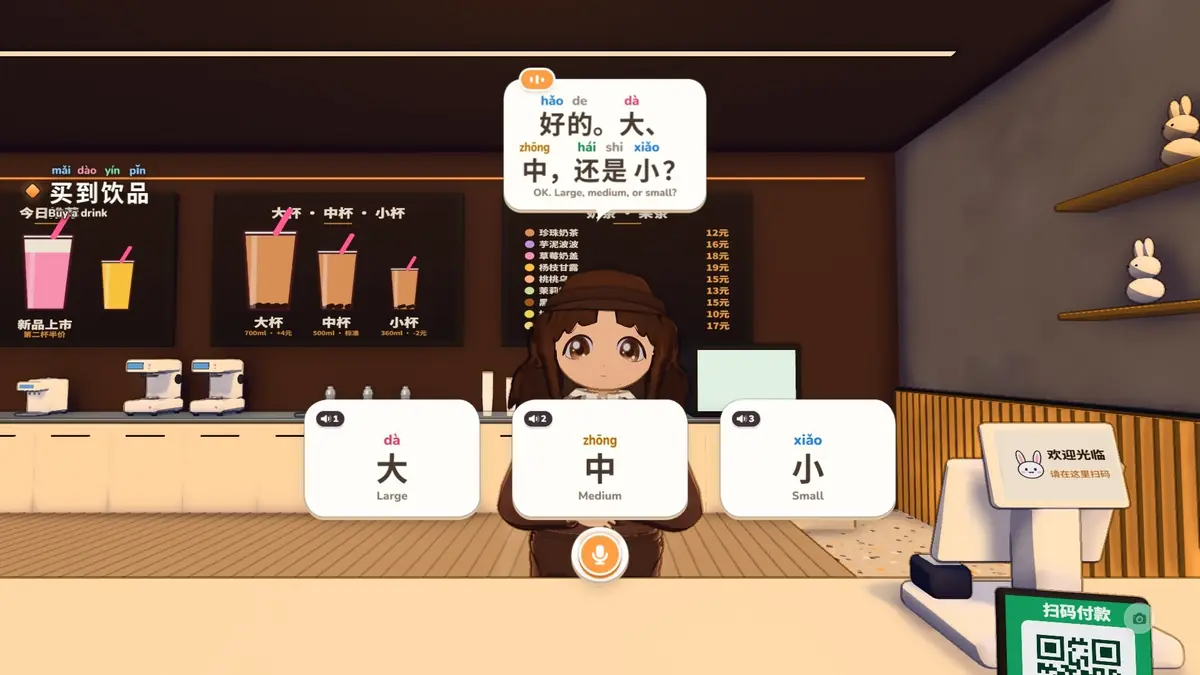
Milk tea shops ask the size and if you want ice. Small restaurants ask if you want it spicy. You order every day, so you learn these answers fast.
-
A fast cashier
A convenience store cashier may ask several questions at once. Say you do not understand and ask them to slow down.
-
Getting sick far from home
At some point, food may upset your stomach. At a pharmacy, you say what hurts, say what you ate, and need to understand how often to take the medicine.
Phrases to learn
- 我叫…… (wǒ jiào……) My name is…
Use it to introduce yourself. Say your name after it, or your Chinese name.
They may say 我叫阿婷,她叫小周。你叫什么名字? (wǒ jiào ā tíng, tā jiào xiǎo zhōu. nǐ jiào shén me míng zi?) I'm Ating, she's Xiaozhou. What's your name? (Two new friends at a night-market table in the game.) - 我来了三天了。 (wǒ lái le sān tiān le.) I’ve been here three days.
Say it when someone asks how long you have been here. Change the number as the weeks go by.
- 只会一点点 (zhǐ huì yì dián diǎn) Only a tiny bit
Say it when someone asks if you speak Chinese, or says your Chinese is good.
They may say 你学中文多久了? (nǐ xué zhōng wén duō jiǔ le?) How long have you been learning Chinese? (Often the next question.) - 一个人? (yí ge rén?) By myself.
Say it when someone asks if you came alone.
They may say 一个人跑这么远,厉害! (yí ge rén pǎo zhè me yuǎn, lì hai!) One person, running this far. Impressive! - 好的 (hǎo de) OK / sure
Say it when someone suggests adding each other on WeChat. Then one of you scans the other’s code.
They may say 我们加个微信吧! (wǒ men jiā ge wēi xìn ba!) Let's add each other on WeChat! - 大杯。 (dà bēi.) A large one.
Say it when you order a drink and they ask the size. A small one is 小杯 (small cup).
They may say 要冰吗? (yào bīng ma?) Want ice? - 听不懂,请慢一点。 (tīng bu dǒng, qǐng màn yì diǎn.) Don't understand, please a bit slower.
Say it when someone talks faster than you can follow.
They may say 好的好的,我慢慢说。 (hǎo de hǎo de, wǒ màn man shuō.) OK, OK, I will say it slowly. - 我肚子疼。 (wǒ dù zi téng.) I have a stomachache.
Say it at a pharmacy or a front desk when your stomach hurts.
They may say 你好,哪里不舒服? (ní hǎo, ná li bù shū fu?) Hello, where do you feel unwell? (The pharmacist’s first question.)
The pinyin shows how the words are really said, as in the game.
Where to practise it in the game
The game has no university campus. But most of what a new student does outside class is in it.
The night market
You ask for a free seat and end up sharing a table with locals. They ask your name, if you are a student and if you came alone. Later that evening, someone suggests adding each other on WeChat.
The milk tea shop
At a mall, you choose a size, say if you want ice and pay by scanning the code.
Mistaken for a student
In a convenience store, an older woman thinks you are a student and asks which university. You say you are not a student, you came to visit.
The pharmacy
You wake up with a stomach ache and ask the hotel desk where a pharmacy is. You tell the pharmacist what you ate, and ask her to explain the medicine again, more slowly.
Practical tips
-
Get a Chinese phone number early
Many apps need a Chinese mobile number, including food delivery, bike sharing and some banking apps. Your university will usually tell you where to get a SIM card.
-
Ask the international office about registration
Foreign residents must register their address with the local police. Students on a long-term study visa also apply for a residence permit soon after arrival. The international office usually helps with both. Ask them about the deadlines, because rules change.
-
Set up WeChat and a payment app before you go
Classes, clubs and friends use WeChat. Set it up at home, where you have time for the account checks. Link a card to WeChat Pay or Alipay.
-
Use the questions as practice
You will hear the same questions many times. Prepare short, true answers, and add a little more each time.
Questions
How much Chinese do I need to study abroad in China?
For an English-taught programme, very little. But daily life outside class is in Mandarin: shops, restaurants, pharmacies and small talk. The first weeks are easier if you can answer a few common questions and make simple requests out loud.
What do people ask foreign students in China?
Four questions come up most: 你是哪里人 (where are you from), 你是学生吗 (are you a student), 你学中文多久了 (how long have you studied Chinese) and 一个人 (by yourself). Prepare a short spoken answer to each.
How do you add someone on WeChat in Chinese?
Someone says 我们加个微信吧 (let’s add each other on WeChat). Answer 好的 (OK). Then one of you shows a QR code in the WeChat app, and the other scans it.
I’ve studied Chinese in class. Why is it hard to understand people in China?
Because people in shops and on the street speak at full speed, ask several questions at once, and use short spoken forms that textbooks teach late. You can always say 听不懂,请慢一点 (I don’t understand, please speak more slowly). Most people will repeat it.
Can a game help me prepare for a semester in China?
Yes, with the part classes cover least: answering out loud in everyday situations. In Very Chinese Time in My Life, you speak to shop owners, drivers, a pharmacist and new friends in a present-day Chinese city. The phrases come back in reviews each night.
Does the game follow the HSK?
No. The HSK is China’s official Chinese test. Very Chinese Time in My Life is organised by situations, not HSK levels. Most of its words are beginner words, so you can use it alongside HSK 1–3 study for speaking practice.
Sources
Official pages for the facts on this page. Rules change, so check them before you travel.
- National Immigration Administration: Regulations on filing accommodation registration for foreignersHotels register foreign guests; anyone staying elsewhere registers with the local police within 24 hours.
- National Immigration Administration: Online accommodation registration nationwide (Announcement No. 7 of 2026)Since 21 September 2026 the registration can also be done online: NIA website, NIA 12367 app, WeChat or Alipay mini program.