Shopping and paying
How to shop at a convenience store in China
Updated
At a Chinese convenience store checkout, the cashier asks up to four quick questions: 1. heat it up? 2. a bag? 3. are you a member? 4. a receipt? Two words answer them all: 要 (yes, want) and 不要 (no, don’t want). This page goes through a visit from the door to paying.
What does a Chinese convenience store sell?
Drinks, snacks and hot food. Chain convenience stores are on almost every street in big Chinese cities, and many are open 24 hours. Hot food sits by the counter: steamed buns in a glass cabinet, tea eggs, and 关东煮 (oden), skewers of fish balls and tofu in hot broth. The fridges have boxed lunches and rice balls, which the cashier heats for you.
Many stores have a counter with stools by the window, so you can eat there. When it rains, umbrellas appear in a stand by the door.
The checkout is quick. The cashier scans your things, asks a few questions in one breath, then shows you where to scan to pay.
Step by step
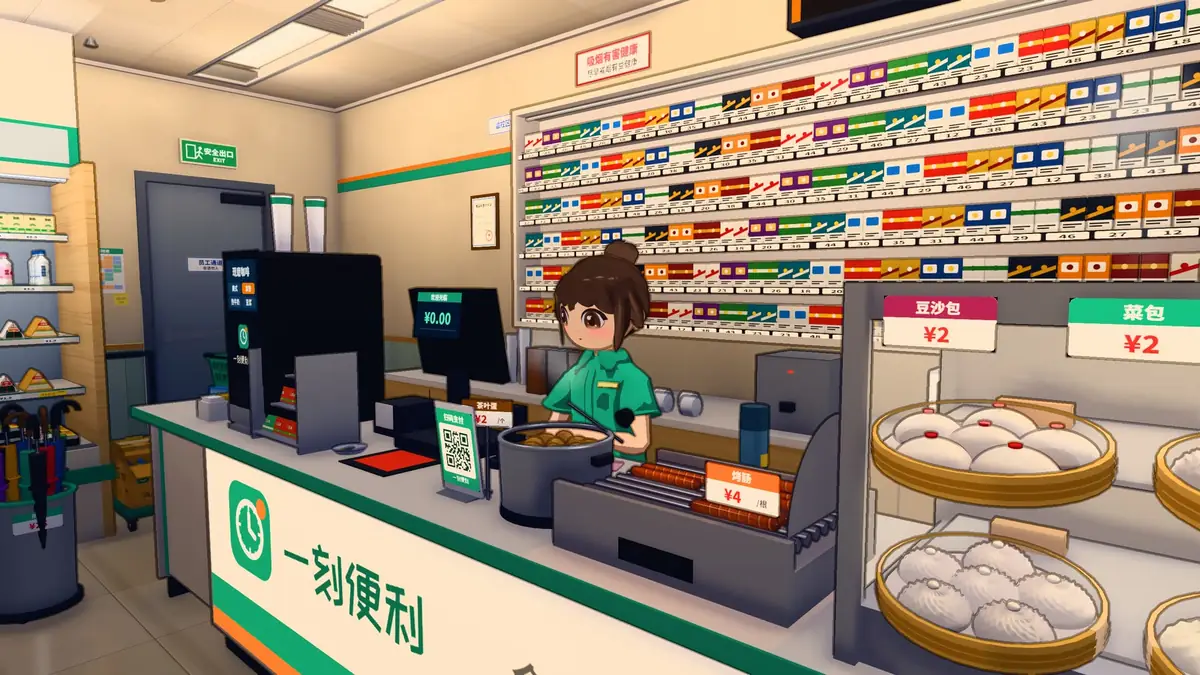
From the door to the window seat. The cashier’s lines come from the convenience store in the game.
-
Walk in
A chime sounds and staff call out a greeting. You do not need to answer.
- You will hear 欢迎光临! (huān yíng guāng lín!) Welcome! (The standard shop greeting. No answer needed.)
-
Pick from the hot counter
Hot food is behind the counter. Point at what you want, and the cashier asks how many.
- 我要这个。 (wǒ yào zhè ge.) I want this one.
Say it while you point at something in the hot cabinet.
They may say 几个? (jǐ ge?) How many? - 两个 (liǎng ge) Two
Say it for two.
-
-
Heat it up or not
For a boxed lunch or rice ball from the fridge, the cashier asks if you want it heated. They use the microwave behind the counter.
- You will hear 您好!要加热吗? (nín hǎo! yào jiā rè ma?) Hello! Want it heated? (加热 (heat up))
- 要 (yào) Want
Yes, heat it. One word is a full answer.
They may say 好的,帮你热一下。 (hǎo de, bāng nǐ rè yí xià.) OK, I will heat it for you. - 不要 (bú yào) Don't want
No, don’t heat it.
They may say 好的,不热。 (hǎo de, bú rè.) OK, no heating.
-
A bag, membership, a receipt
Three more questions. 1. Bags cost a little extra in Chinese shops, so they ask if you want one. 2. Chains have member programmes. As a visitor, just say no. 3. A 小票 (receipt) is the printed receipt.
- You will hear 要袋子吗? (yào dài zi ma?) Want a bag?
- You will hear 有会员吗? (yǒu huì yuán ma?) Are you a member? (A shake of the head is enough.)
- You will hear 小票要吗? (xiǎo piào yào ma?) Want a receipt? (小票 (receipt))
- 不要 (bú yào) Don't want
Say it for no bag or no receipt.
They may say 好的,不要袋子。 (hǎo de, bú yào dài zi.) OK, no bag.
-
When the questions come too fast
Cashiers ask these questions all day, so they run them together. Ask them to slow down. Most will then ask each question on its own.
- 听不懂,请慢一点。 (tīng bu dǒng, qǐng màn yì diǎn.) Don't understand, please a bit slower.
Say it if you did not catch what the cashier said.
They may say 好的好的,我慢慢说。 (hǎo de hǎo de, wǒ màn man shuō.) OK, OK, I will say it slowly. (Then the questions come one at a time.)
-
-
Pay
The cashier asks if you will scan or pay cash, then says the price and points at the code or reader.
- You will hear 扫码还是现金? (sáo mǎ hái shi xiàn jīn?) Scan the code or cash?
- 扫码 (sáo mǎ) Scan the code
Say it to pay by phone.
They may say 十二块,扫这里。 (shí èr kuài, sǎo zhè lǐ.) 12 yuan. Scan here.
-
If it starts raining
People buy umbrellas at convenience stores when the weather turns. Staff put the umbrella stand by the door as soon as it rains.
- You will hear 下雨了,雨伞在这里! (xià yǔ le, yú sǎn zài zhè lǐ!) It's raining, umbrellas are here!
- 雨伞多少钱? (yú sǎn duō shao qián?) How much is the umbrella?
Ask it for the price of an umbrella. 雨伞 (umbrella).
They may say 二十五。扫这里。 (èr shí wǔ. sǎo zhè lǐ.) Twenty-five. Scan here.
The pinyin shows how the words are really said, as in the game.
Practical tips
-
Many are open all night
In big cities, many convenience stores are open 24 hours. They are useful late at night for water, food or a phone charger.
-
Bring a bag
Shops in China charge for plastic bags. Keep a folding bag in your pocket and you can always say 不要 (don’t want).
-
Let the cashier heat it
The microwave is behind the counter. Hand over the box at the till, and the cashier heats it while you pay.
-
Eat at the window
Many stores have a counter and stools by the window for eating what you just bought.
Where to practise it in the game
In Very Chinese Time in My Life, the convenience store is lunch on the second day. The checkout is built around those fast questions.
Mistaken for staff
While you look at the shelves, a man asks you 老板,这个多少钱 (boss, how much is this). You answer 我不是店员 (I’m not a clerk), and he goes off, embarrassed, to ask the real one. Then an old lady asks you to reach something on a high shelf.
The checkout
The cashier fires off all four questions at once, faster than the subtitles. You say 听不懂,请慢一点 (I don’t understand, please speak more slowly). She repeats each one slowly, one word at a time, and you answer 要 (yes) or 不要 (no). Then you scan to pay.
The rain
You eat at the window. A sudden downpour sends a soaked delivery rider through the door. He bumps into you and says sorry. The cashier wheels out the umbrella stand, and you ask 雨伞多少钱 (how much is an umbrella) before you walk out under your new umbrella.
Questions
What does 要加热吗 mean?
要加热吗 (do you want it heated) is what cashiers ask when you buy a boxed meal or rice ball. Answer 要 (yes) or 不要 (no).
Do you have to pay for plastic bags in China?
Yes. Shops and supermarkets in China charge a little for plastic bags. That is why cashiers ask 要袋子吗 (want a bag). Bring your own bag to avoid the charge.
What does 有会员吗 mean?
有会员吗 (are you a member) is about the store’s member programme. If you are not a member, just shake your head.
What is a 小票?
A 小票 (receipt) is a printed receipt. When a cashier asks 小票要吗 (want the receipt), answer 要 (yes) or 不要 (no).
Are convenience stores in China open 24 hours?
Many are, in big cities, but not all. The hours are usually on the door.
Can I pay cash at a convenience store in China?
Yes. They take cash and phone payments. The cashier will ask 扫码还是现金 (scan or cash).