Eating
How to order breakfast at a street stall in China
Updated
Ordering at a Chinese breakfast stall takes five steps: 1. point at the food and say 这个 (this one), 2. say how many, 3. say if you eat there or take it away, 4. pay by scanning the QR code, 5. take the food. This page explains what the stall sells, then goes through each step with what you say and hear.
What is a breakfast stall?
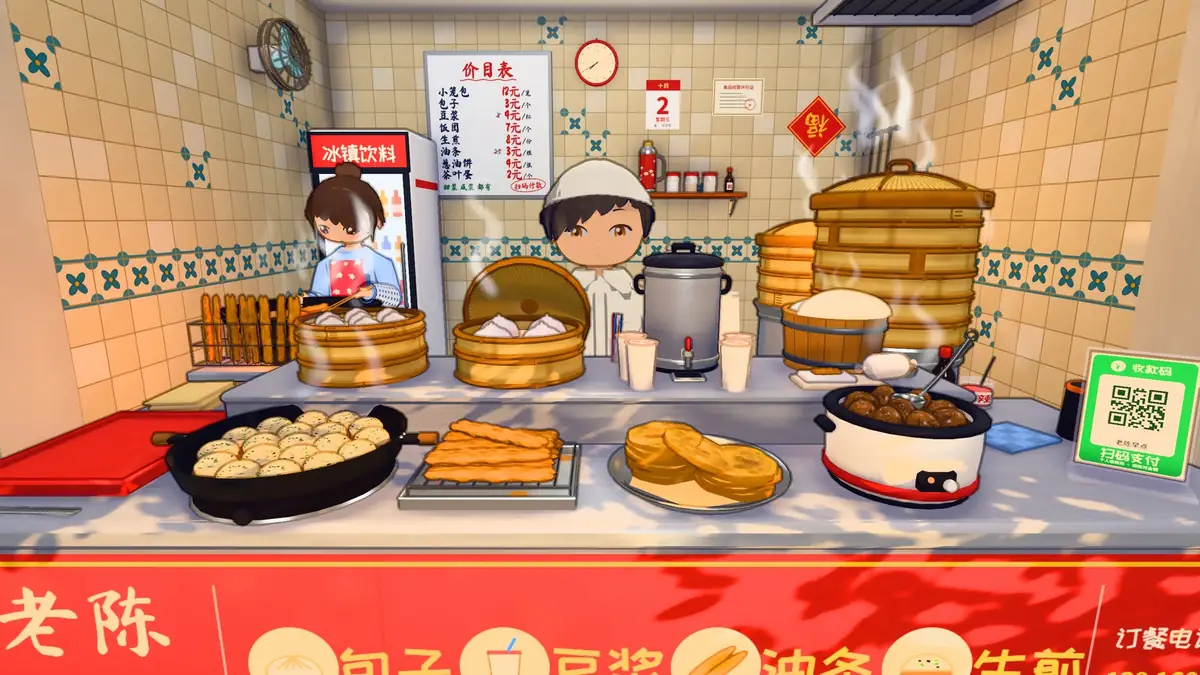
A breakfast stall is a small shop that opens onto the street and sells hot breakfast to take or eat there. The front is a counter with bamboo steamer baskets, a wide flat pan, a pot of soy milk and a tray of fried food. Stalls are busiest before work, and some close by late morning.
What they sell depends on the region. Common foods are 包子 (steamed bun with a filling), 小笼包 (small soup dumplings), 生煎 (buns fried on the bottom), 油条 (fried dough stick), 葱油饼 (scallion pancake), 茶叶蛋 (egg simmered in tea), 饭团 (sticky rice roll) and 豆浆 (soy milk).
Prices are low, usually a few yuan for a bun or a dough stick. People say a price as a number plus 块, the everyday word for yuan. There is often a price board on the wall and a QR code on the counter for paying by phone.
Step by step
In the order they happen. “You will hear” is what the owner says in the game. The cards are what you say.
-
Point at what you want
You do not need the names of the foods. Point and say 这个 (this one). When the owner asks how many, they usually say the food’s name first, so you learn it.
- You will hear 好嘞,要哪个? (hǎo lei, yào nǎ ge?) OK, which one do you want? (The owner is ready for your order.)
- 这个 (zhè ge) This one
Say it while you point. It works for anything on the counter.
They may say 包子?想要几个? (bāo zi? xiǎng yào jǐ ge?) Steamed bun? How many? (They name what you pointed at and ask how many.)
-
Say how many
Copy the owner’s word. In Chinese, a small counting word goes between the number and the food, and the owner’s question already has the right one. Answer with your number plus that word.
- You will hear 油条?想要几根? (yóu tiáo? xiǎng yào jǐ gēn?) Fried dough stick? How many sticks? (根 is the counting word for long, thin things.)
- You will hear 小笼包?想要几笼? (xiǎo lóng bāo? xiǎng yào jǐ lóng?) Soup dumplings? How many baskets? (笼 is one steamer basket of soup dumplings.)
- 一个 (yí ge) One
Say it for one bun, one egg or one rice roll. 个 is the general counting word.
They may say 一个包子,好嘞! (yí ge bāo zi, hǎo lei!) One steamed bun, got it! (The owner repeats your order.) - 两根 (liǎng gēn) Two sticks
Say it for two fried dough sticks. For two, say 两, not 二. Both mean “two”, but 两 goes before a counting word.
They may say 两根油条,好嘞! (liǎng gēn yóu tiáo, hǎo lei!) Two fried dough sticks, got it!
-
Answer “anything else?”
After each item, the owner asks if you want more. Point and say 这个 (this one) again, or say no.
- You will hear 还要别的吗? (hái yào bié de ma?) Anything else?
- 不用了 (bú yòng le) No need
Say it when you have everything. It means “no need”. It is softer than a plain “no”.
-
For here or to go
Many stalls have a few low tables and stools. If you eat there, the owner brings the food over. If you take it away, they pack it in a bag.
- You will hear 在这里吃还是带走? (zài zhè lǐ chī hái shi dài zǒu?) For here or to go?
- 在这里吃 (zài zhè lǐ chī) For here
Say it to eat at the stall.
They may say 你坐那边,我给你端过去! (nǐ zuò nà biān, wǒ gěi nǐ duān guò qu!) You sit over there, I'll bring it over to you! - 带走 (dài zǒu) To go
Say it to take the food with you.
They may say 好嘞,给你打包! (hǎo lei, gěi nǐ dǎ bāo!) OK, I'll pack it for you! (They pack it in a bag.)
-
Pay
The owner tells you the total. Open Alipay or WeChat Pay, scan the QR code on the counter, type the amount and confirm. Some owners want to see your screen. Others listen to a small speaker that reads out each payment.
- You will hear 您怎么付款? (nín zěn me fù kuǎn?) How will you pay?
- 扫码付款 (sáo mǎ fù kuǎn) Scan the code to pay
Say it to pay by phone. Then scan the code on the counter.
They may say 好嘞,没问题! (hǎo lei, méi wèn tí!) Sure, no problem! - 多少钱? (duō shao qián?) How much?
Ask it if you did not catch the total.
They may say 五块。 (wǔ kuài.) Five yuan. (A number plus 块 is a price in yuan.)
-
Take the food and say goodbye
Food from the steamer and the pan is very hot. Owners often warn you as they hand it over.
- You will hear 东西拿好,小心烫啊! (dōng xi ná hǎo, xiǎo xīn tàng a!) Here you go — careful, it's hot!
- You will hear 慢走啊,明天再来! (màn zǒu a, míng tiān zài lái!) Take care, come again tomorrow! (慢走 (walk slowly) is how shop owners say goodbye.)
- 谢谢 (xiè xie) Thank you
Say it when you take the food, and again as you leave.
The pinyin shows how the words are really said, as in the game.
Practical tips
-
Go early
The best choice is from about 7 to 9 in the morning. Later, popular items may be sold out.
-
Look at the price board
Most stalls list each item and its price in yuan. Check it before you order, so you know the total.
-
Bite soup dumplings carefully
Soup dumplings are full of hot broth. Bite a small hole first to let the steam out, or tip the broth into a spoon.
-
Carry small notes
Almost everyone pays by phone. Most stalls still take cash, but a 100-yuan note for a 3-yuan bun can leave the owner short of change.
-
Bring tissues
Small breakfast shops often have no napkins.
Where to practise it in the game
Very Chinese Time in My Life is a week in a present-day Chinese city, spoken out loud. Breakfast at a street stall is the first morning.
The first morning: the breakfast stall
Eight foods sit on the counter, and you know none of their names. You point and say 这个 (this one). The owner names the food and asks how many, and you answer with a number. You choose to eat inside or take it away, then say 扫码付款 (pay by scanning the code) and scan the code.
If you only buy soy milk
The owner will not let you leave with just a drink. She asks 不买点吃的吗 (not buying something to eat), then says 光喝豆浆,吃不饱的 (soy milk alone won’t fill you up). You have to pick some food too.
After you eat
A woman at the stall asks if you are local and where you are going today. You answer her before you set off.
Questions
What do people in China eat for breakfast?
Hot, quick food from a street stall: 包子 (steamed buns), 豆浆 (soy milk), 油条 (fried dough sticks), 小笼包 (soup dumplings) or a 葱油饼 (scallion pancake). It changes from region to region. Many people eat it on the way to work.
How do I order at a Chinese breakfast stall if I don’t know the names of the food?
Point at the food and say 这个 (this one). Owners are used to it. They usually say the food’s name back to you when they ask how many.
What does 在这里吃还是带走 mean?
在这里吃还是带走 (for here or to go) is the question at every food counter. Answer 在这里吃 (eat here) to eat at the stall, or 带走 (to go) to take the food away.
Why does the owner say 几根 or 几笼 instead of 几个?
Because Chinese puts a counting word between a number and a thing, and the word depends on the thing. 根 is for long, thin things like dough sticks. 笼 is a steamer basket. 个 is the general one, for buns and eggs. Answer with the number and the same word, for example 两根 (two sticks).
Can I pay with cash at a breakfast stall in China?
Yes. Cash is legal in China and most stalls take it, though nearly everyone pays with Alipay or WeChat Pay. Small notes are easier for the owner to change than a 100-yuan note.
How much does a street breakfast cost in China?
A few yuan for a bun, a tea egg or a dough stick. A basket of soup dumplings costs more. Prices are higher in big cities and are usually on a board on the wall.