Getting around
How to ask for directions and take the metro in China
Updated
To ask the way in China, say 不好意思 (excuse me), then ask 地铁站在哪里 (where is the metro station). Or show your map and ask 在哪里 (where is it). This page covers stopping a stranger, what people say back, and what happens at the station: the bag check, the gates and the platform.
What should you expect?
Most big Chinese cities have a metro, the 地铁 (metro). Signs in stations and trains are in Chinese and English, and station names are also in pinyin. Street entrances have the city’s metro logo, but they can be hard to spot among shops. That is when people ask the way.
Asking a stranger the way is normal in China. Start with 不好意思 (excuse me). People also use friendly words for strangers: 帅哥 (handsome guy) for a young man, 美女 (beautiful lady) for a young woman, 阿姨 (auntie) for a middle-aged woman, and 叔叔 (uncle) for a middle-aged man. These are polite, everyday words.
At the station entrance, there is a bag check: your bag goes through an X-ray machine, like at an airport but faster. Then come the ticket gates. In many cities, you scan a QR code on your phone to go through. Machines also sell single tickets.
Step by step
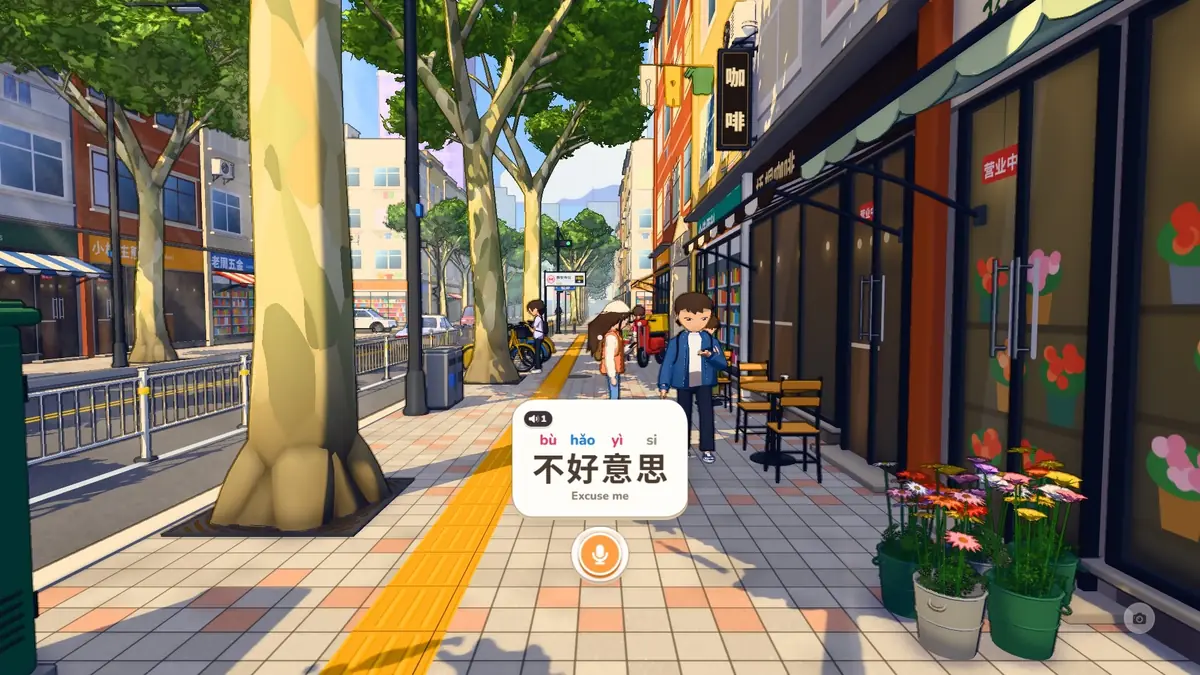
From the street to the train. The lines come from the walk to the metro on the second morning of the game.
-
Stop someone politely
Pick someone who is not rushing. Say “excuse me” and wait for them to look at you. If they wave you off, try the next person.
- 不好意思 (bù hǎo yì si) Excuse me
Say it to get a stranger’s attention. It means “excuse me” or “sorry”.
They may say 哎,什么事? (āi, shén me shì?) Oh? What is it? (They are listening. Some just say 怎么了 (what’s up).)
-
-
Ask where it is
Ask for the metro station, or hold up your map and ask “where is it?”. 在哪里 (where is) works for anything: the station, a pharmacy, the toilet.
- 地铁站在哪里? (dì tiě zhàn zài ná li?) Where's the metro station?
Ask it to find the metro station.
They may say 地铁站啊?前面,右转。 (dì tiě zhàn a? qián mian, yòu zhuǎn.) The metro station? Up ahead, turn right. - 在哪里? (zài ná li?) Where is it?
Ask it while you show your map or a photo of the place.
-
-
If they don’t know or can’t stop
Many people on the street are visitors too, and some are in a hurry. Thank them and ask someone else. Older locals and shop staff usually know the area best.
- You will hear 不好意思,我也不知道。 (bù hǎo yì si, wǒ yě bù zhī dào.) Sorry, I don't know either.
- You will hear 我也是来玩的,不知道哎。 (wǒ yě shì lái wán de, bù zhī dào āi.) I'm also here to have fun. I don't know. (They are visiting too.)
- You will hear 不好意思,我赶时间! (bù hǎo yì si, wǒ gǎn shí jiān!) Sorry, I'm in a hurry!
- 没关系 (méi guān xi) It's OK
Say it to mean “that’s OK”. Then try someone else.
-
Understand the directions
Directions are short: ahead, left or right, straight on. People point as they talk. Repeat the directions back to check you understood.
- You will hear 往那边一直走,然后左转。 (wǎng nà biān yì zhí zǒu, rán hòu zuó zhuǎn.) Go straight that way, then turn left.
- 前面,右转 (qián mian, yòu zhuǎn) Up ahead, turn right
Say it back to check you heard “up ahead, turn right”.
- 谢谢 (xiè xie) Thank you
Say it once you know the way.
They may say 不客气! (bú kè qi!) You're welcome!
-
Through security and the gates
Put your bag on the X-ray belt and walk through. At the gates, hold the metro QR code in your app to the reader, or use a ticket. Keep it ready, because you scan again on the way out in most cities.
- You will hear 包放上面。 (bāo fàng shàng mian.) Put your bag up here. (Security staff point to the X-ray belt.)
-
On the platform
Each train’s direction is shown by its last stop. If someone chats with you while you wait, a short answer is fine. Children are often curious about foreign visitors.
- You will hear 你是中国人吗? (nǐ shì zhōng guó rén ma?) Are you Chinese?
- You will hear 我们可以合照吗? (wǒ men ké yǐ hé zhào ma?) Can we take a photo together?
- 我是外国人 (wǒ shì wài guó rén) I'm a foreigner
Say it to mean you are not from China.
- 可以 (ké yǐ) Can
Say it for “yes, you can”. For “sorry, no”, say 不好意思,不行 (sorry, no).
The pinyin shows how the words are really said, as in the game.
Practical tips
Metro payment differs from city to city. Check the metro’s own website or app for your city.
-
Use a local map app
Local map apps such as Amap (Gaode) show metro entrances, exits and walking routes accurately. Set one up before you need it.
-
Check the exit before you leave
Big stations have many exits, labelled with letters or numbers. The map app or the station map shows which exit is closest.
-
Have the place name in Chinese
Show the place name in Chinese characters. It avoids confusion over pronunciation, especially with older people.
-
Avoid rush hour with luggage
Trains in big cities are packed on weekday mornings and evenings. With a suitcase, travel outside those times.
-
Drinks and security
Security staff may ask about drinks in your bag. A bottle of water is normally fine.
Where to practise it in the game
In Very Chinese Time in My Life, the second morning starts on a street where your map will not settle and you cannot find the metro.
Asking the way
You stop people with 不好意思 (excuse me) and ask 地铁站在哪里 (where is the metro station), a sentence you build from two parts the first time. A young man with earphones does not know. A tourist with a camera is a visitor too. An office worker is in a hurry. Then an older woman pulling a shopping trolley tells you 前面,右转 (up ahead, turn right).
Into the station
At the gates, you say 手机 (phone) to take out your phone and scan your way in.
On the platform
A little girl runs up and says 你好 (hello). She asks if you are Chinese. When you say you are a foreigner, she asks for a photo together. You take it in the game’s photo mode, and she gets a printed copy.
Questions
How do I ask where the metro station is in Chinese?
Say 地铁站在哪里 (where is the metro station). Start with 不好意思 (excuse me) to get the person’s attention.
How do I politely get a stranger’s attention in China?
Say 不好意思 (excuse me). In many cities, people also call strangers 帅哥 (handsome guy) for a young man, 美女 (beautiful lady) for a young woman, or 阿姨 (auntie) for a middle-aged woman. These are normal, polite words.
How do foreigners pay for the metro in China?
In many cities, you scan a QR code from a phone app at the gate. Machines also sell single tickets. Which apps and cards work depends on the city, so check the city metro’s website or app before you go.
Why is there a security check at metro stations in China?
It is a routine safety check at every entrance in big cities. Put your bag on the X-ray belt, walk through and pick it up. It takes a few seconds.
Are metro signs in China in English?
Yes. In big cities, metro signs, maps and announcements are in Chinese and English. Station names are also in pinyin.
What does 前面,右转 mean?
前面,右转 (up ahead, turn right). Two more you will hear: 左转 (turn left) and 一直走 (go straight on).