Getting around
How to take a high-speed train in China as a foreigner
Updated
To take a high-speed train in China, buy a ticket in your passport’s name and bring that passport to the station. There, you go through five steps: 1. ID check, 2. bag check, 3. wait for your train, 4. go through the gate, 5. find your car on the platform. This page goes through each step with the Chinese you will hear.
How does train travel in China work?
High-speed trains, 高铁 (high-speed rail), link most big Chinese cities. Their train numbers start with G. Stations are big, often far from the old centre, and work like airports: an ID check at the door, a bag check, a large waiting hall, and a gate that opens shortly before departure.
Tickets are sold in your name and linked to your ID. For a foreign visitor, that is the passport. You can buy tickets on the official railway site and app, 12306, which has an English version. You can also use travel apps, or the ticket office at the station. Usually there is no paper ticket. Staff check your passport against the booking.
Most people travel in second class, 二等座 (second-class seat), with five seats in a row. First class and business class cost more and have fewer, wider seats.
Step by step
From the ticket office to your seat. The lines come from the station and the train in the game.
-
Buy a ticket at the counter
If you did not book online, go to the ticket office. Say where you are going and what time, and hand over your passport. The clerk usually offers second class.
- You will hear 你好,去哪里? (ní hǎo, qù ná li?) Hello. Where to?
- You will hear 几点 (jí diǎn) What time?
- 一张去柳溪的票。 (yì zhāng qù liǔ xī de piào.) One ticket to Liuxi.
One ticket to Liuxi, the town in the game. Say your own destination instead of 柳溪 (Liuxi).
- 护照 (hù zhào) passport
Say it when the clerk asks for your passport.
-
Seat class and price
The clerk checks the seat class and tells you the price. Once you pay, the ticket is linked to your passport.
- You will hear 二等座,可以吗? (èr děng zuò, ké yǐ ma?) Second class, is that OK? (Second class is the standard seat.)
- You will hear 六十八块。 (liù shí bā kuài.) 68 yuan.
- You will hear 好了!车票在你手机上。 (hǎo le! chē piào zài nǐ shǒu jī shàng.) All done! The ticket is on your phone. (The ticket is electronic and linked to your passport.)
- 可以 (ké yǐ) Can
Say it to mean “yes, that’s fine”.
-
The ID check at the entrance
At the entrance, staff check each passenger’s ID against their ticket. Chinese passengers use automatic gates with their ID card. These may not read foreign passports, so staff often send foreigners to a lane where a person checks documents.
- You will hear 这边来! (zhè biān lái!) Over here! (Staff wave you to the staffed lane.)
- You will hear 身份证? (shēn fèn zhèng?) ID card? (They mean a Chinese ID card.)
- 我是外国人 (wǒ shì wài guó rén) I'm a foreigner
Say it when they ask for a Chinese ID card.
They may say 护照呢? (hù zhào ne?) And your passport? (Hand it over.)
-
Security
Your bag goes through an X-ray machine, and you walk through a scanner. Staff may ask about drinks in your bag.
- You will hear 包放上面。 (bāo fàng shàng mian.) Put your bag up here.
- You will hear 有水吗? (yǒu shuǐ ma?) Any water? (They may ask about drinks in your bag.)
- You will hear 好,过去吧。 (hǎo, guò qu ba.) OK, go on through.
-
Watch the board and the gate
Big screens in the waiting hall list each train by number, time and gate. Boarding is announced shortly before departure. The gate closes a few minutes before the train leaves.
- You will hear G1357次列车开始检票了。 (G yāo sān wǔ qī cì liè chē kāi shǐ jiǎn piào le.) Train G1357 is now boarding. (检票 (ticket check) at the gate has started. Boarding is open.)
- You will hear 检票了!走吧! (jiǎn piào le! zǒu ba!) They're boarding! Let's go!
-
Find your car on the platform
Your booking shows a car number and a seat. Car numbers are marked on the platform floor, so stand where your car will stop. Staff stand by each door.
- You will hear 看地上的号! (kàn dì shang de hào!) Look at the numbers on the ground! (Car numbers are on the platform floor.)
- You will hear 上车吧! (shàng chē ba!) Get on board!
- 四号车厢? (sì hào chē xiāng?) Car four?
Ask it to check you are at the right car. 车厢 (train car). Put your own car number first.
-
On board
Find your row and seat. If someone is in your seat, show your booking and say so politely. It is usually a mistake. A trolley comes through with drinks and snacks.
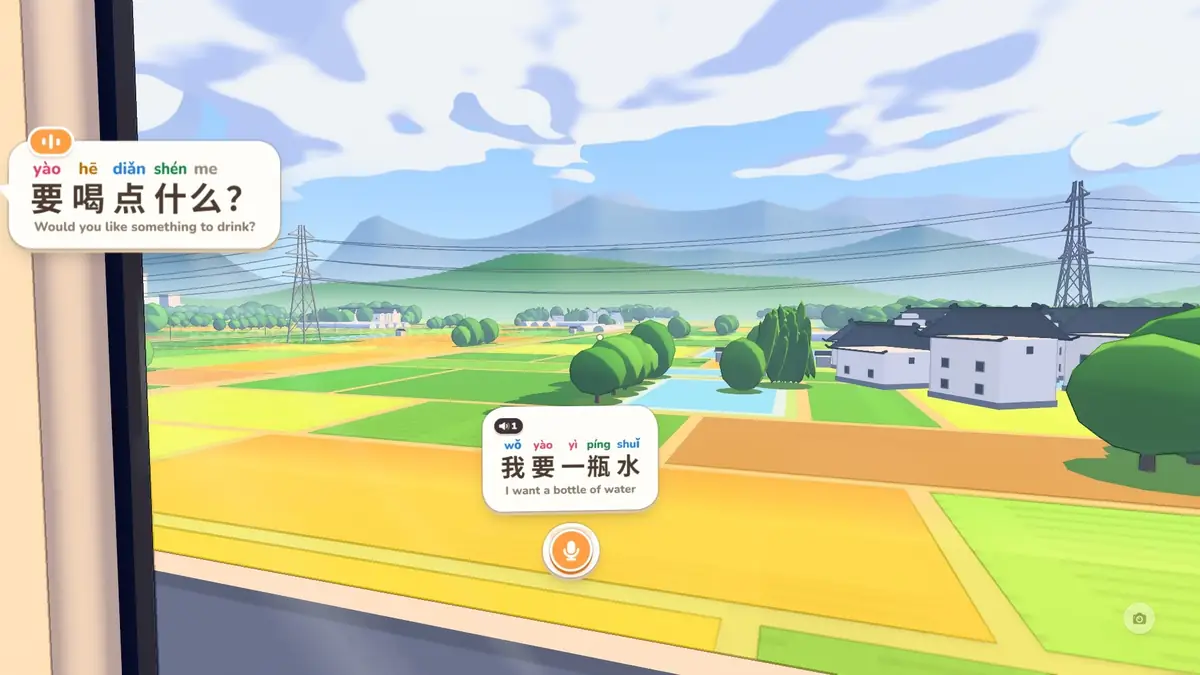
- You will hear 要喝点什么? (yào hē diǎn shén me?) Would you like something to drink? (The drinks trolley comes through the car.)
- 不好意思,这是我的位子。 (bù hǎo yì si, zhè shì wǒ de wèi zi.) Excuse me, this is my seat.
Say it if someone is sitting in your seat.
- 我要一瓶水 (wǒ yào yì píng shuǐ) I want a bottle of water
Say it when the trolley comes by and you want water.
They may say 三块。 (sān kuài.) Three yuan.
The pinyin shows how the words are really said, as in the game.
Practical tips
Booking rules for foreign passengers change. Check them on 12306 or in your booking app before you go.
-
Book early around holidays
Trains sell out around Chinese New Year and the national holiday in early October. At other times, popular routes can still sell out a few days ahead.
-
Use the exact name in your passport
The name on the booking must match your passport. Type it exactly as on the photo page.
-
Arrive early
The ID check, the bag check and the walk to the gate take time, especially in a big station you do not know.
-
Keep your passport in your hand
You need it at the entrance and sometimes at the gate. Staff on the train may check it too.
-
Window or aisle
In second class, each row has seats A, B, C, then the aisle, then D and F. A and F are by the window. C and D are by the aisle.
Where to practise it in the game
In Very Chinese Time in My Life, day 6 starts at a high-speed rail station. A friend has invited you to an old water town.
The ticket window
You build 一张去柳溪的票 (one ticket to Liuxi) from three parts, tell the clerk the time, say 护照 (passport) to hand it over, accept a second-class seat and pay by scanning. She tells you the ticket is on your phone.
The entrance and security
Staff wave you to the staffed lane and ask for your 身份证 (ID card). You say 我是外国人 (I’m a foreigner) and show your passport. At security, you put your bag on the belt and say if you have any water.
Boarding and the ride
You buy breakfast in the station, wait with your friend under the departure board, and hear your train called. You find car four by the numbers on the floor. On board, someone is in your seat, and the drinks trolley comes by.
Questions
Can foreigners buy high-speed train tickets in China?
Yes, with a passport. Buy them on the official railway site and app, 12306, which has an English version, in travel booking apps, or at the station ticket office. The ticket is in the name on your passport.
Do I need a paper ticket for trains in China?
Usually not. Most tickets are electronic and linked to your ID. For a foreign visitor, that is the passport. Staff check it at the station entrance and the gate.
What does 二等座 mean?
二等座 (second-class seat) is the standard, most common class on high-speed trains. A ticket clerk may ask 二等座,可以吗 (second class, is that OK).
How early should I arrive at a train station in China?
Well before departure. You have to pass an ID check and a bag check before the waiting hall, and the gate closes a few minutes before the train leaves. Big stations also take a while to walk through.
Which seats are window seats on a Chinese high-speed train?
In second class, seats A and F are by the window. C and D are by the aisle. B is the middle seat of the three.
What does 检票 mean?
检票 (ticket check) is the check at the boarding gate. When you hear that a train 开始检票了 (has started the ticket check), boarding has started.
Can I bring water through security at a Chinese train station?
Usually yes. A normal bottle of water is allowed. Staff may ask about drinks and liquids in your bag.
Sources
Official pages for the facts on this page. Rules change, so check them before you travel.
- China Railway 12306 (English)The official site for buying train tickets in China, with an English version.