Working with China
Chinese for teaching English in China
Updated
Foreign teachers in China work in English and live in Mandarin. Buying lunch, finding a pharmacy, talking to neighbours and reporting a lost phone are up to you. People also ask you the same questions again and again. This page covers that everyday side and the phrases for it.
Daily life outside school
-
Being taken for a student
Older people often think a young foreigner studies at the local university, and ask which one. A short answer about what you do is enough.
-
Children saying hello
Children may greet you in English, ask if you are Chinese, or want a photo with you. They mean it kindly. You can say no.
-
Questions in the park
Older people in parks ask direct questions: your name, if you speak Chinese, if you are married. In China, this is normal small talk, not rude.
-
Errands after work
You buy fruit at a market, where it is sold by weight. You pay at a convenience store, and buy an umbrella when it rains. The school does not do these for you.
-
When something goes wrong
In your first months, you may need a pharmacy for a stomach ache, or the police station for a lost phone.
Phrases to learn
- 我不是学生 (wǒ bú shì xué sheng) I’m not a student
Say it when someone thinks you study at the local university.
They may say 你是这里的学生吗?哪个大学的? (nǐ shì zhè lǐ de xué sheng ma? nǎ ge dà xué de?) Are you a student here? Which university? (This is the question you hear first.) - 不好意思,不行 (bù hǎo yì si, bù xíng) Sorry, no
Say it to say no when someone asks for a photo.
They may say 我们可以合照吗? (wǒ men ké yǐ hé zhào ma?) Can we take a photo together? (Often asked by a child.) - 可以 (ké yǐ) Sure, you can
Say it to agree to a photo, or to most polite requests.
- 我叫…… (wǒ jiào……) My name is…
Use it to introduce yourself to neighbours and colleagues. Say your name after it.
- 我没有结婚 (wǒ méi yǒu jié hūn) I'm not married
Use it to answer “are you married?”. If you are, say 我已经结婚了 (I’m already married).
They may say 你结婚了吗? (nǐ jié hūn le ma?) Are you married? - 一斤。 (yì jīn.) One jin (500 g).
Use it to buy fruit or vegetables. Markets sell food by weight, and prices are per 斤 (jin). One jin is 500 grams. Ask the price per jin before you buy.
- 雨伞多少钱? (yú sǎn duō shao qián?) How much is the umbrella?
Ask it when it starts to rain and the shop puts umbrellas out by the door.
- 我的手机丢了。 (wǒ de shǒu jī diū le.) My phone is lost.
Say it at a hotel desk, your school office or a police station.
They may say 你的手机是什么颜色的? (nǐ de shǒu jī shì shén me yán sè de?) What color is your phone?
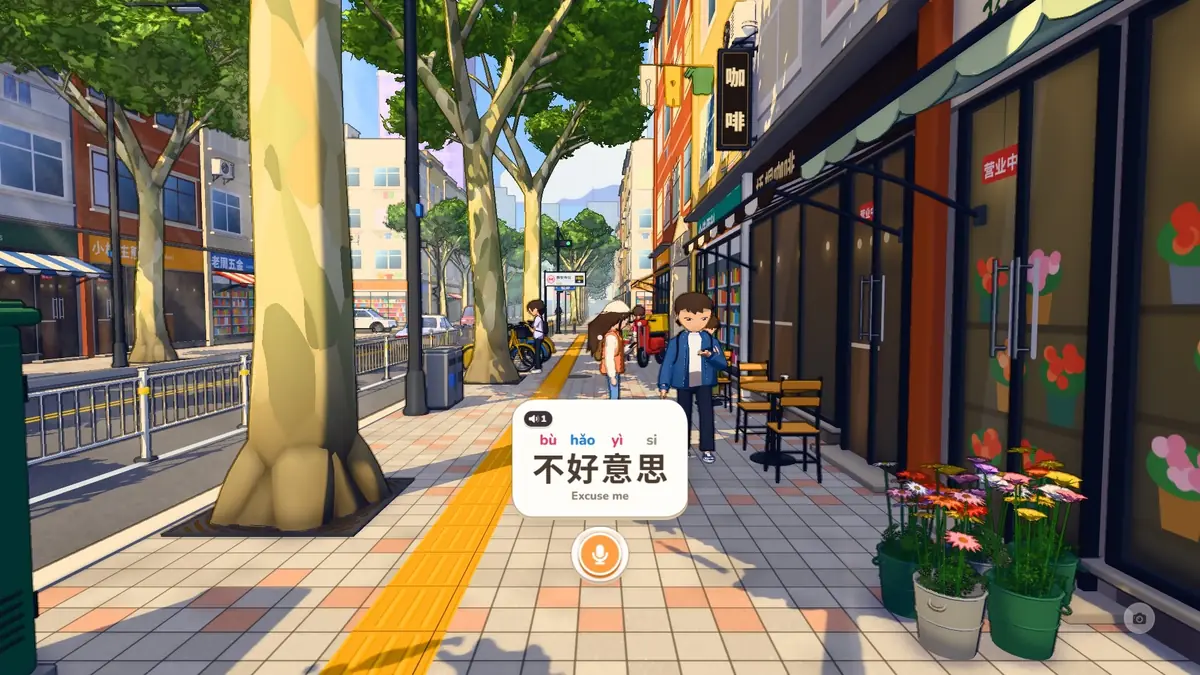
The pinyin shows how the words are really said, as in the game.
Where to practise it in the game
The game covers one week, not a school term. But you meet the same kinds of people a new teacher meets.
The convenience store
You help an older woman reach a high shelf. She thinks you are a student and asks which university. You tell her you are not a student. Later, when it pours, you buy an umbrella at the counter.
The metro platform
A child says “Hello! 你好!”, asks if you are Chinese, and asks for a photo together. You can say yes or no.
The park
You spend a morning walking around a park. People dance, play chess, write characters on the ground with water and walk dogs. At the matchmaking corner, parents look for partners for their grown-up children. They ask if you are married.
The fruit shop, the pharmacy, the police station
You buy fruit by the jin, explain a stomach ache to a pharmacist, and report a lost phone at a local police station by saying its colour.
Practical tips
-
Register your address
If you do not stay in a hotel, you must register your address with the local police within 24 hours of arriving, and again after you move. Hotels do this for guests. Schools usually help new teachers. Since September 2026, you can also register online, in the National Immigration Administration’s NIA 12367 app or website.
-
Save your addresses in Chinese
Save your home and school addresses in Chinese characters on your phone. Drivers, couriers and the police ask for them.
-
Learn the jin
Markets price fruit and vegetables per 斤 (jin). One jin is 500 grams, so the price on the sign is for half a kilo.
-
Ask your colleagues
Chinese colleagues can help with phone contracts, deliveries and doctors. A few phrases of your own mean you ask them less often.
Questions
Do I need to speak Chinese to teach English in China?
No. English teaching jobs in China do not usually require Chinese, and classes are in English. Daily life outside school is in Mandarin, so a few spoken phrases for shops, transport, the pharmacy and small talk help a lot.
What questions do people in China ask foreign teachers?
Where you are from, if you are a student, if you speak Chinese, if you are married, and how long you have been in China. Two short answers cover most of them: 我不是学生 (I’m not a student) and 我没有结婚 (I’m not married).
How do I politely refuse a photo in Chinese?
Say 不好意思,不行 (sorry, no). It is polite and clear. To say yes, 可以 (sure) is enough.
What is a jin in China?
A 斤 (jin) is the unit for weighing food at Chinese markets. One jin is 500 grams, a little over one pound. Market prices are usually per jin.
Where do I register my address in China?
At the local police station, a 派出所 (police station), within 24 hours of arriving. Hotels register their guests themselves. Since September 2026, you can also register online, in the National Immigration Administration’s NIA 12367 app or website. Many schools help new teachers with this.
Can I learn enough Chinese before my teaching contract starts?
Yes, enough for errands and small talk, if you practise speaking and not only reading. Very Chinese Time in My Life has you say everyday phrases out loud in shops, a park, a pharmacy and a police station.
Sources
Official pages for the facts on this page. Rules change, so check them before you travel.
- National Immigration Administration: Regulations on filing accommodation registration for foreignersHotels register foreign guests; anyone staying elsewhere registers with the local police within 24 hours.
- National Immigration Administration: Online accommodation registration nationwide (Announcement No. 7 of 2026)Since 21 September 2026 the registration can also be done online: NIA website, NIA 12367 app, WeChat or Alipay mini program.