People
How to visit a Chinese family at home (and make dumplings)
Updated
When a Chinese family invites you home for a meal, bring fruit and greet the oldest people first. Expect tea, help making dumplings, and more food until you say 吃饱了 (I’m full). This page follows one visit step by step, from buying the fruit to the toast.
What is a home visit like?
An invitation home for a meal is a sign of real friendship in China. The meal is relaxed and noisy. Several generations may be there. The older people usually cook, and they are the ones who tell you to eat more.
Guests bring a gift. Fruit is common, because everyone shares it after the meal. Good tea, snacks or something from your country also work. Fruit is sold by the 斤 (jin): one jin is half a kilo, about 1.1 pounds. Price signs show the price per jin.
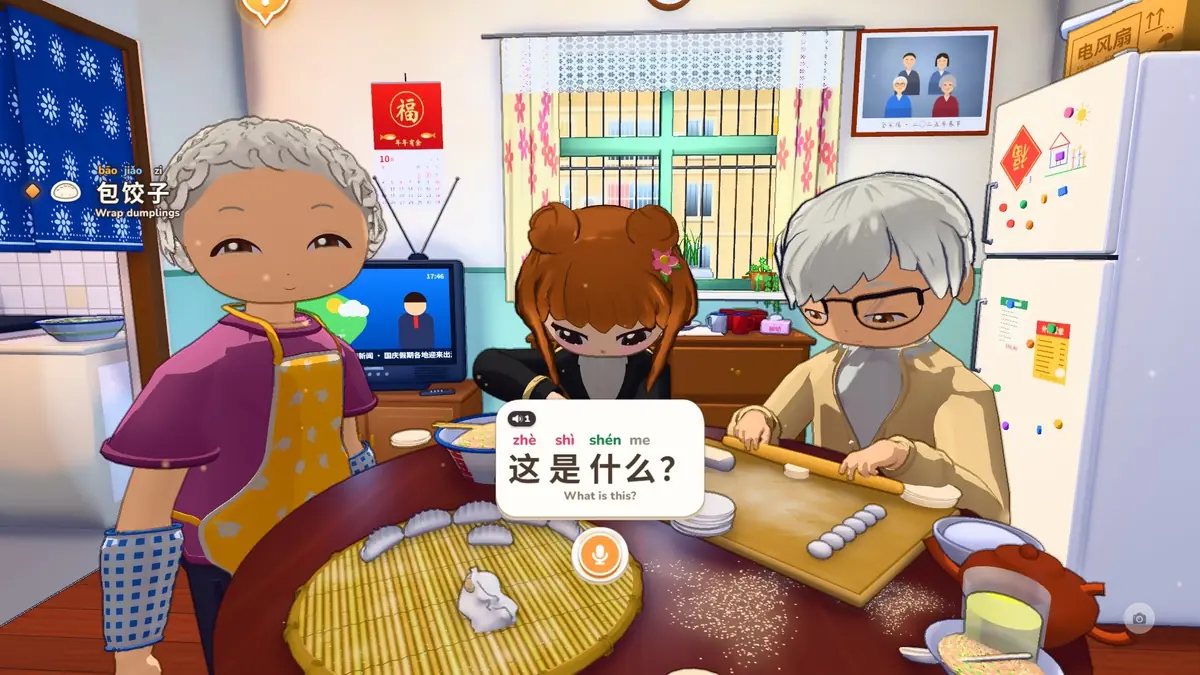
Many families live in flats. Older buildings often have stairs and no lift. In many homes, people take off their shoes at the door and wear slippers, and the host will offer you a pair. Families often make 饺子 (dumplings) together with guests: the filling is ready, and everyone sits at the table folding them.
Step by step
One visit, start to finish. The lines come from the family visit in the game.
-
Buy a gift: fruit by the jin
Fruit shops put the price per jin on a sign above each crate. Say how many jin you want, or pick the fruit and they weigh it. Sellers often say the fruit is sweet before you ask.
- You will hear 早上好!要点什么? (zǎo shang hǎo! yào diǎn shén me?) Good morning! What do you want?
- 我先看看。 (wǒ xiān kàn kan.) I'll take a look first.
Say it to look around before you choose.
They may say 随便看! (suí biàn kàn!) Look as you like! - 苹果一斤多少钱? (píng guǒ yì jīn duō shao qián?) How much is one jin of apples?
Ask it for the price of apples per jin. Swap in another fruit, like 橙子 (oranges).
- 两斤。 (liǎng jīn.) Two jin.
Say it for two jin, about one kilo. For two, say 两, not 二. Both mean “two”, but 两 goes before a counting word.
-
Tell the seller it’s a gift
Sellers often guess when you are buying a gift, and may pick out the best pieces. Asking if it is sweet is normal.
- You will hear 是礼物吧? (shì lǐ wù ba?) It's a gift, right?
- 礼物。 (lǐ wù.) A gift.
Say it to mean yes, it is a gift.
- 甜吗? (tián ma?) Is it sweet?
Ask it to find out if the fruit is sweet.
They may say 甜!不甜不要钱! (tián! bù tián bú yào qián!) Sweet! Not sweet, no money! (Fruit sellers say this a lot.)
-
Arrive and greet the family
Greet the oldest people first, by family title: 奶奶 (grandma), 爷爷 (grandpa), 阿姨 (auntie) and 叔叔 (uncle). Auntie and uncle are also what you call your friend’s parents. Hand over the gift with both hands. Hosts often say you should not have brought anything.
- You will hear 快进来快进来! (kuài jìn lái kuài jìn lái!) Come in quickly, come in quickly!
- You will hear 哎哟,还带东西! (āi yō, hái dài dōng xi!) Oh my, you even brought something! (Hosts often say this when you give a gift.)
- 奶奶好 (nǎi nai hǎo) Hello, grandma
Say it to greet a grandmother. For anyone older, put their title before 好 (good) the same way.
- 给你的 (gěi nǐ de) For you
Say it as you hand over the gift. It means “for you”.
-
Wash your hands, sit down, have tea
They show you where to wash your hands and where to sit. Then they offer you a drink, usually tea.
- You will hear 先洗手! (xiān xí shǒu!) Wash hands first!
- You will hear 坐坐坐!喝什么? (zuò zuò zuò! hē shén me?) Sit, sit, sit! What will you drink?
- You will hear 绿茶还是红茶? (lǜ chá hái shi hóng chá?) Green tea or black tea?
- 我想喝茶。 (wǒ xiǎng hē chá.) I want to drink tea.
Say it if you would like tea.
- 绿茶 (lǜ chá) green tea
Say it to choose green tea.
They may say 来,喝茶。 (lái, hē chá.) Here, drink tea.
-
Make dumplings together
Nobody expects you to know how. Someone will show you: 1. a spoon of filling in the middle of the round wrapper, 2. fold it in half, 3. pinch the edges shut. Too much filling makes it burst in the pot.
- You will hear 会包饺子吗? (huì bāo jiǎo zi ma?) Can you wrap dumplings?
- You will hear 放馅,对折,捏紧。 (fàng xiàn, duì zhé, niē jǐn.) Put in filling, fold in half, pinch tight.
- You will hear 馅太多了!少一点。 (xiàn tài duō le! shǎo yì diǎn.) Too much filling! A little less.
- 不会 (bú huì) Can't
Say it if you have never made them. It means “I can’t”. Your lesson starts here.
They may say 不会?我教你! (bú huì? wǒ jiāo nǐ!) Can't? I'll teach you! - 这样? (zhè yàng?) Like this?
Ask it while you hold up your dumpling, to check you are doing it right.
They may say 对对对! (duì duì duì!) Right right right!
-
Eat, and be fed more
Boiled dumplings are dipped in vinegar, sometimes with chili. Hosts keep putting food on your plate to look after you. When you have had enough, say you are full. You may need to say it more than once.
- You will hear 蘸醋吗? (zhàn cù ma?) Dip in vinegar? (Boiled dumplings are dipped in vinegar.)
- You will hear 多吃点多吃点! (duō chī diǎn duō chī diǎn!) Eat more, eat more!
- You will hear 再吃两个! (zài chī liǎng ge!) Eat two more!
- 真好吃! (zhēn hǎo chī!) Really tasty!
Say it to praise the food. Hosts love to hear it.
They may say 好吃就好! (hǎo chī jiù hǎo!) If it's tasty, that's good! - 吃饱了 (chī bǎo le) I’m full
Say it when you cannot eat any more.
They may say 行行行,吃饱了就好! (xíng xíng xíng, chī bǎo le jiù hǎo!) OK OK OK, full is good! (All right, all right, as long as you’re full!)
-
Raise a glass, and keep in touch
The host may make a short toast that ends in 干杯 (cheers). You can toast with tea or a soft drink. Before you leave, people often add each other on WeChat by scanning one person’s QR code.
- You will hear 来!我们相聚有缘分,干杯! (lái! wǒ men xiāng jù yǒu yuán fèn, gān bēi!) Come! We meet together, there is fate, cheers! (A short toast about fate bringing people together.)
- You will hear 扫我的。 (sǎo wǒ de.) Scan mine. (They show their WeChat QR code for you to scan.)
- 干杯! (gān bēi!) Cheers!
Say it when glasses go up.
The pinyin shows how the words are really said, as in the game.
Practical tips
-
Bring a gift
Fruit, tea, sweets or something from your home country are all good. Hand it over with both hands.
-
Take your shoes off if others do
Look at the shoes by the door. If the family’s shoes are there and they offer slippers, change into them.
-
Greet the oldest first
Say hello to the grandparents before anyone else. Using the family titles makes people smile.
-
Pace yourself
More food will keep coming. Eat slowly, and say 吃饱了 (I’m full) clearly when you are done.
-
Tea is fine for toasts
You do not have to drink alcohol. Raise whatever is in your glass.
Where to practise it in the game
In Very Chinese Time in My Life, day 4 is spent with a family you met earlier in the week, from buying the gift to dancing in the square after lunch.
The fruit shop
The night before, a friend invites you to lunch to make dumplings. In the morning, you buy fruit at a little shop. You say 我先看看 (I’ll look first), ask the price per jin, ask for one, two or three jin, say it is a gift and ask if it is sweet. The first time you see 斤 (jin), a small card shows that one jin is 500 g, about 1.1 lb.
The stairs
On the way up, an older woman is struggling with her shopping in a building with no lift. You help her carry it to the fifth floor. She turns out to be your friend’s mother.
Lunch
Inside, you greet grandma and grandpa, wash your hands and choose green or black tea. You learn to fold dumplings, and they tell you when you use too much filling. You dip them in vinegar and get told to eat two more, until you say 吃饱了 (I’m full). The meal ends with a toast and adding each other on WeChat.
Questions
What gift should I bring to a Chinese family’s home?
Fruit is one of the most common gifts, because it is shared after the meal. Good tea, snacks or something from your country also work. Hand the gift over with both hands.
How much is one jin?
One 斤 (jin) is half a kilo: 500 grams, or about 1.1 pounds. Fruit, vegetables and meat in China are priced per jin, so 两斤 (two jin) is one kilo.
How do I say “I’m full” in Chinese?
Say 吃饱了 (I’m full). Chinese hosts often keep serving guests, so you may need to say it more than once.
What do I call my Chinese friend’s parents and grandparents?
Call the grandparents 奶奶 (grandma) and 爷爷 (grandpa), and the parents 阿姨 (auntie) and 叔叔 (uncle). Add 好 (good) after the title for a polite hello: 奶奶好 (hello, grandma).
Should I take my shoes off in a Chinese home?
Often, yes. Many families take off their shoes at the door and wear slippers inside. If you see shoes by the door and the host offers slippers, change into them.
How do you fold Chinese dumplings?
In three steps: 放馅,对折,捏紧 (add filling, fold in half, pinch shut). Put a spoon of filling in the middle of a round wrapper, fold it in half, and pinch the edges tightly. Too much filling makes it burst when boiled.
Do I have to drink alcohol when Chinese hosts make a toast?
No. Raise a glass of tea or a soft drink and say 干杯 (cheers) with everyone else.