Working with China
Chinese for a business trip to China
Updated
On a business trip to China, the meetings are usually in English or with an interpreter. Almost everything else is in Chinese: the airport, the hotel desk, shops, drivers and dinner with your hosts. This page goes through those moments in order, with a short phrase for each.
What will happen
In the order they usually happen.
-
Drivers at the arrivals exit
In the evening, people at the exit may offer you a car before you reach the taxi rank. They ask once, ask again, then say the price is low. A short, polite “no” works better than ignoring them.
-
A driver who wants to chat
Ride-hailing drivers often ask where you are from, how long you have been here, and if you like spicy food. They are being friendly. Short answers are fine.
-
The hotel desk asks for an ID card
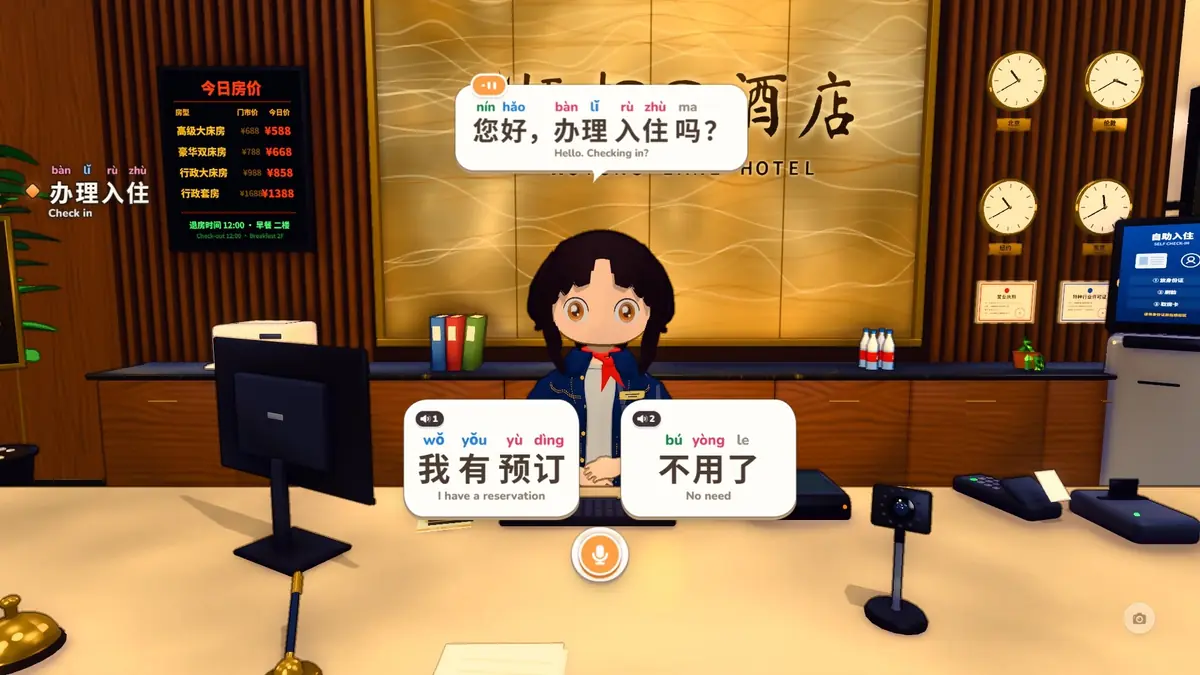
Every Chinese citizen has a national ID card, a 身份证 (ID card). Most guests are Chinese, so receptionists ask for it first. Say you are a foreigner and they will ask for your passport. Some hotels also ask you to look into a camera on the desk.
-
A fast cashier between meetings
When you buy water or a snack, the cashier may ask three quick questions: heat it up, a bag, and how you will pay. You can ask them to speak more slowly. Most people will.
-
Dinner with your hosts
The hosts usually order for the whole table. They raise their glasses several times and keep putting food on your plate. You need the word for “cheers” and a way to say you are full.
-
Someone says your Chinese is good
Say one sentence in Chinese and people will often say your Chinese is good. The usual reply is a modest one, like “only a little”.
Phrases to learn
You say each of these out loud in the game, in the place where it is used.
- 不用了,谢谢 (bú yòng le, xiè xie) No need, thanks
Say it to drivers at the arrivals exit, and to anyone offering something you do not want. It means “no need”. It sounds softer than a plain “no”.
They may say 很便宜的! (hěn pián yi de!) It's very cheap! (They often try once more.) - 我有预订 (wǒ yǒu yù dìng) I have a reservation
Say it first at the hotel desk if you booked ahead.
They may say 好的。身份证出示一下。 (hǎo de. shēn fèn zhèng chū shì yí xià.) OK. Please show your ID card. (They are asking for a Chinese ID card, out of habit.) - 我是外国人 (wǒ shì wài guó rén) I'm a foreigner
Say it when someone asks for a Chinese ID card. They will then ask for your passport.
They may say 哦,不好意思!护照给我一下。 (ò, bù hǎo yì si! hù zhào gěi wǒ yí xià.) Oh, sorry! Give me your passport, please. - 晚上好! (wǎn shang hǎo!) Good evening!
Say it when you get into a car or walk into a hotel in the evening. Greet people before you ask for anything.
They may say 晚上好!是去酒店吗? (wǎn shang hǎo! shì qù jiǔ diàn ma?) Good evening! Going to the hotel? - 好几天了 (háo jǐ tiān le) Quite a few days
Say it when a driver asks 来多久了 (how long have you been here).
They may say 好几天了?都快成本地人了! (háo jǐ tiān le? dōu kuài chéng běn dì rén le!) Quite a few days? Almost a local already! - 听不懂,请慢一点。 (tīng bu dǒng, qǐng màn yì diǎn.) Don't understand, please a bit slower.
Say it when someone speaks too fast. In the game, the cashier then repeats each question slowly, one word at a time.
They may say 好的好的,我慢慢说。 (hǎo de hǎo de, wǒ màn man shuō.) OK, OK, I will say it slowly. - 干杯! (gān bēi!) Cheers!
Say it when people raise their glasses at dinner. The host often says a few words first, then ends with this.
- 吃饱了 (chī bǎo le) I’m full
Say it when your hosts keep putting food on your plate. You may need to say it more than once.
They may say 行行行,吃饱了就好! (xíng xíng xíng, chī bǎo le jiù hǎo!) All right, all right, good that you’re full! - 只会一点点 (zhǐ huì yì dián diǎn) Only a tiny bit
Say it when someone says your Chinese is good. It is the modest reply.
They may say 一点点?说得很好了! (yì dián diǎn? shuō de hěn hǎo le!) A tiny bit? You speak very well!
The pinyin shows how the words are really said, as in the game.
Where to practise it in the game
The game is a week in a present-day Chinese city. These parts match a business trip.
The first night: airport, car, hotel
The game starts at the arrivals exit at night. Two drivers try to sell you a ride, and you say no out loud. Your booked car picks you up, and the driver asks where you are from. At the hotel desk, you say you have a reservation, say you are a foreigner, and say the word for passport to take it out.
A daytime ride across town
Later in the week, a ride-hailing driver asks the usual questions: where you are going, how long you have been here, if you came alone, and if you like spicy food. Then he says your Chinese is good.
The convenience store checkout
The cashier asks her questions too fast. You say you do not understand and ask her to slow down. She repeats them one slow word at a time.
Meals with toasts
At a night-market dinner and a family lunch, people raise their glasses and ask if you like the food. They keep serving you until you say you are full.
What about a sourcing trip or a trade fair?
The game does not teach bargaining or trade words. For negotiations, you still need an interpreter.
It does teach the basics those talks use: numbers, asking 多少钱 (how much), asking someone to slow down, and catching a price when you hear it.
Spoken prices are a number plus 块, the everyday word for yuan. Every cashier in the game says prices this way.
Practical tips
-
Set up phone payment before you fly
Most small shops, stalls and taxis expect you to pay by scanning a QR code with your phone. The two apps are Alipay and WeChat Pay. Both let visitors link a foreign Visa or Mastercard. Install one, add a card and try a small payment before the trip.
-
Book cars in an app
DiDi is the main ride-hailing app in China. It has an English version and also works inside Alipay. The app sends your destination to the driver and shows the fare, so you do not have to explain the address or agree on a price.
-
Carry your real passport
Hotels register foreign guests with the passport itself. Train stations check it at the ticket window and the gates. A photo or photocopy is usually not accepted.
-
Have your hotel address in Chinese
Many drivers do not know the English name of your hotel. Keep a screenshot of the name and address in Chinese to show them.
-
Let the host order
At a business dinner, the host usually orders and serves the guests. If you do not drink alcohol, toast with tea or a soft drink.
Questions
Do I need to speak Chinese for a business trip to China?
No. Most business meetings with foreign visitors are in English or with an interpreter. Basic spoken Chinese helps with the rest of the trip: taxis, the hotel desk, shops, meals and small talk.
What Chinese phrases are most useful on a business trip?
Short, polite phrases for getting around: 不用了,谢谢 (no need, thanks), 我有预订 (I have a reservation), 我是外国人 (I’m a foreigner) when a desk asks for an ID card, 听不懂,请慢一点 (I don’t understand, please speak more slowly) and 干杯 (cheers).
Why does the hotel ask me for an ID card?
Out of habit. Most hotel guests in China are Chinese citizens, so staff ask for a Chinese ID card, a 身份证 (ID card). Foreign guests check in with a passport. Say 我是外国人 (I’m a foreigner) and the receptionist will ask for your passport.
How do I answer when someone says my Chinese is good?
Answer modestly, for example 只会一点点 (I only know a little). People in China often praise foreigners who say a few words in Chinese. A modest reply is the usual answer.
What do I say for a toast at a business dinner in China?
Say 干杯 (cheers) when glasses are raised. If you do not drink alcohol, toast with tea or a soft drink.
Can I pay with a foreign credit card in China?
Sometimes. Large hotels and some restaurants take foreign credit cards, but most everyday payments are by QR code in Alipay or WeChat Pay. Both apps let visitors link a foreign Visa or Mastercard, so set one up before the trip.
Is Very Chinese Time in My Life a business Chinese course?
No. Very Chinese Time in My Life teaches everyday spoken Mandarin for getting around, eating, paying and small talk. It does not teach words for meetings or negotiations. It covers the parts of a business trip outside the meeting room.
Sources
Official pages for the facts on this page. Rules change, so check them before you travel.
- The State Council of China: Payment guide seen as assisting opening-up (People’s Bank of China guide for foreigners)How visitors pay in China with bank cards, cash and mobile payment apps such as Alipay and Weixin Pay (WeChat Pay).
- Alipay: American Express and Alipay to enable payments for international travelers in China (February 2025)International visitors can link cards from seven major card brands to Alipay.